
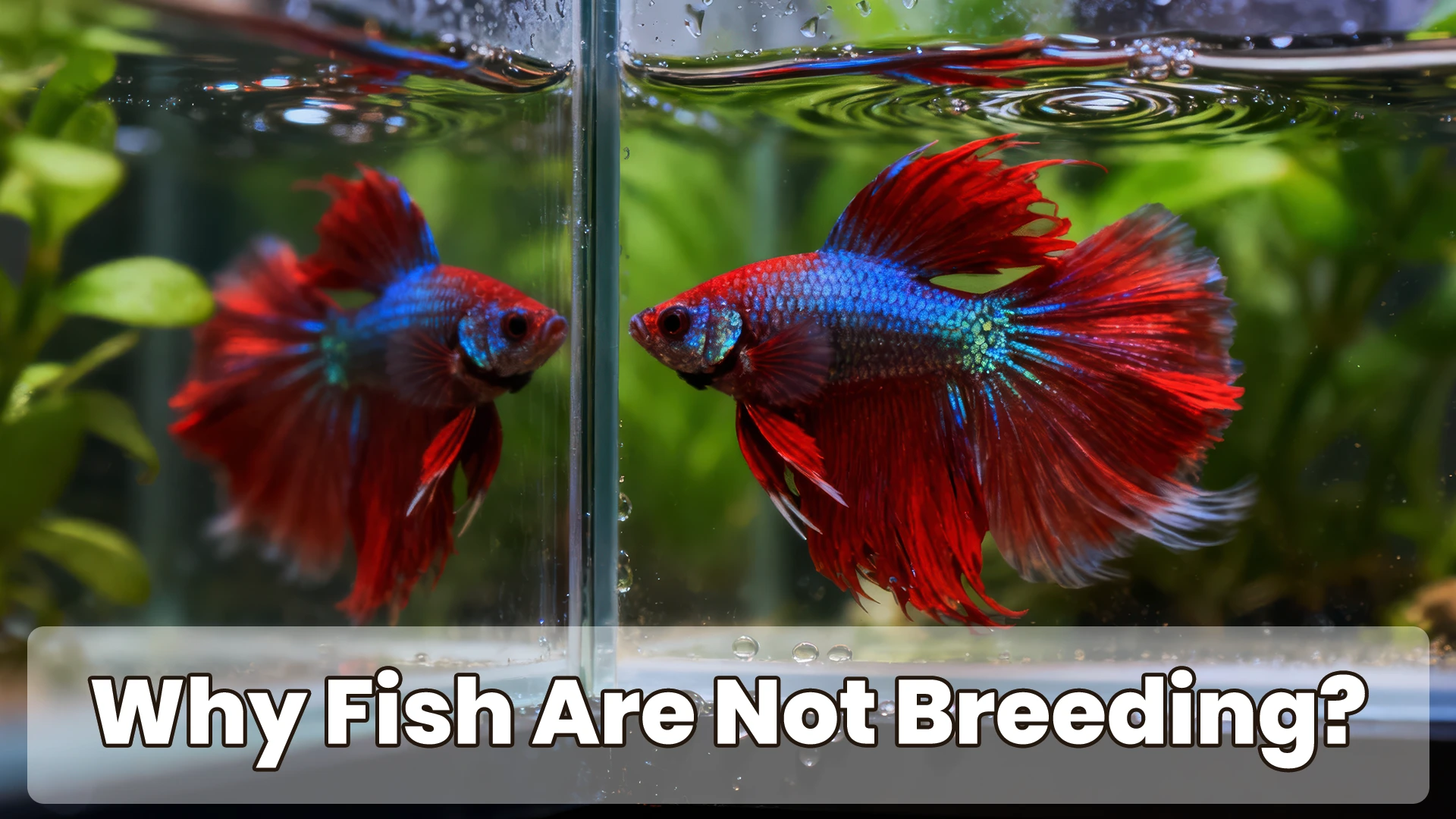
You set up the perfect tank.
You did your research. You bought a decent heater, a sponge filter, some plants. You drove twenty minutes to the fish shop and picked out what the guy behind the counter promised were “a healthy breeding pair.” You got home, acclimated them carefully, turned the lights off to let them settle — and then you waited.
A week passed. Two weeks. A month.
Nothing.
No chasing behaviour. No eggs. No fry. Just two fish swimming around like they have absolutely no interest in each other whatsoever.
I’ve been there. And I remember how genuinely demoralising it is — because it’s not just the money (though that stings too). It’s the time. The hope. The fact that you did everything you were supposed to do and still got nothing to show for it.
Here’s what I’ve learned after seven-plus years of breeding tropical fish: almost every case of “my fish won’t breed” has a fixable cause. Usually more than one. And the good news is, most of them are simpler to solve than you’d expect.
This guide is going to walk you through exactly what’s stopping your fish — and what to do about it. Not generic advice. Real fixes, from someone who has made every one of these mistakes personally.
Let’s start at the beginning.
The Most Common Reasons Fish Stop Breeding
Wrong Sex Ratio — And Yes, I Made This Exact Mistake
I’m going to lead with the most embarrassing story from my early fishkeeping days, because I think it’ll help more people than any amount of technical advice.
When I first started, I went to my local fish shop with the specific goal of getting “a breeding pair of guppies.” Simple enough, right? The shop assistant reached into the tank, scooped up four fish, bagged them, and sent me on my way. I got home. Set everything up. Watched them for weeks.
Not a single fry appeared.
It wasn’t until my cousin — who’d been keeping fish for years — came to visit and said, almost immediately, “Kd, those are all female,” that I understood what had gone wrong.
Four female guppies. Zero males. Of course nothing happened.
The thing is, sexing fish correctly isn’t always obvious, especially when you’re new. For guppies, males are smaller, much more colourful, and have a pointed anal fin called the gonopodium — that’s the modified fin they use for internal fertilisation. Females are larger, plainer in colour, and have a rounded belly. Once you know what you’re looking for, it’s obvious. Before that? Genuinely easy to mix up.
But sex ratio isn’t just about having one of each. For guppies, the recommended ratio is 1 male to every 3 females. Why? Because a single male will relentlessly pursue females, and if he’s outnumbered by females, the pursuit is spread out and less stressful. If you flip the ratio and have more males than females, the females get harassed so aggressively that they become too stressed to carry fry to term.
For bettas, the dynamic is completely different — they can’t cohabitate at all. But we’ll get into that specifically in a later section.
Age Matters More Than You Think
Here’s something that took me embarrassingly long to figure out: fish have a reproductive window, and it’s narrower than most beginners assume.
Male guppies become sexually mature at around 3–5 months old. Females can technically breed as early as 2 months, though experienced breeders usually wait until 4 months for better outcomes — earlier pregnancies can stress a young female and result in weaker fry. On the other end of the spectrum, fish older than 18–24 months tend to show noticeably reduced breeding activity. Fewer attempts, smaller batches, lower fry survival rates.
The challenge is that when you buy fish from a shop, you almost never know their age. You’re essentially buying a mystery. If you’ve been waiting for months with no results and everything else seems fine, age is worth considering seriously.
Stress in the Tank — The Invisible Breeding Killer
This is probably the most underestimated factor on this list, and the one I see beginners overlook most often.
I made this mistake myself. I’d been successfully breeding guppies in a community tank — nothing spectacular, but a steady trickle of fry every few weeks. Then I bought an angelfish. Beautiful fish. Peaceful, even — it never actually attacked the guppies. But within 24 hours of adding it to the tank, breeding had completely stopped.
The guppies were hiding constantly. Not eating well. Barely visible. The angelfish would drift past, and every guppy in the tank would freeze.
It took me two weeks to connect the dots and remove the angelfish. Within another two weeks, breeding had resumed.
Fish will not reproduce when they feel threatened. It’s hardwired survival behaviour — if your environment feels dangerous, bringing offspring into it is biologically counterproductive. Overcrowding triggers the same response. So does a tank placed near a TV that’s frequently loud, or next to a window with lots of street activity, or one that gets tapped on regularly by curious visitors.
The fix is creating genuine calm. Enough space, peaceful tank mates, plenty of hiding spots (plants, caves, driftwood), and a stable, undisturbed environment. If your tank has more than 1 inch of adult fish per gallon of water, overcrowding is almost certainly a factor.
Water Conditions for Fish Breeding — Are You Getting It Right?
A lot of people assume that “the water is fine” because their fish are alive and swimming. But here’s the thing — fish can survive in suboptimal water conditions for a long time before showing visible signs of stress. Breeding, though, is one of the first things to shut down.
Temperature — The Trigger Most People Miss
I’ll be direct about this: temperature is the single most overlooked breeding trigger in home aquariums. And I know this from a frustrating personal experience.
About three years into keeping fish, I decided to try breeding bettas for the first time. I had a healthy male, a well-conditioned female, a proper setup — everything looked good on paper. But my male showed zero interest in building a bubble nest. No flaring at the female. Nothing.
After two weeks of nothing, I checked my thermometer properly — not the dial on the heater, but an actual separate thermometer I stuck in the tank. The water was sitting at 24°C. Technically within the acceptable range for bettas, but on the low end.
I raised it to 27°C over two days. Within five days, my male had started building a bubble nest. Within ten days, they spawned.
Three degrees. That’s all it took.
In the wild, tropical fish use water temperature as a seasonal cue. Warmer water signals the wet season — the time of year when food is abundant, conditions are stable, and raising offspring is viable. When your aquarium temperature sits at the lower end of a species’ range, your fish’s biology reads that as “not yet.” A small upward adjustment mimics the warming that naturally triggers spawning instinct.
Here are the temperature targets I work with personally:
- Guppies: 24–26°C (75–79°F)
- Bettas: 26–28°C (79–82°F)
- Zebra danios: 26–28°C (79–82°F)
- Angelfish: 27–29°C (80–84°F)
- Corydoras: 22–26°C (72–79°F)
Always verify with a separate thermometer. Heater dials are notoriously inaccurate.
pH and Water Hardness — The Sweet Spot Varies by Species
This is where things get a little more technical, but it’s genuinely important — especially if you’re working with species that are even slightly more demanding than guppies.
Guppies are forgiving. They’ll breed in a pH range of 7.0–8.0 with moderately hard water (GH of 10–20 dGH). Most tap water in the UK and Sri Lanka falls somewhere in this range, which is part of why guppies are so beginner-friendly.
Bettas are more particular — they prefer slightly acidic water, around pH 6.5–7.0. Not dramatically different, but enough to matter if your tap water is hard and alkaline.
And then there’s discus. I attempted discus breeding exactly once, in my fourth year of the hobby. Once. They require very soft, acidic water — pH 6.0–6.5, GH below 3 dGH — and are so sensitive to fluctuations that even a partial water change with slightly different water can disrupt spawning. I wasn’t prepared for that level of precision. My discus never spawned, and I eventually rehomed them to someone who actually knew what they were doing.
The lesson? Know your species’ requirements before you invest in the setup. A basic liquid test kit — the API Master Test Kit runs about $25–$35 and tests pH, ammonia, nitrite, and nitrate — is genuinely non-negotiable if you’re serious about breeding.
Dirty Water = No Babies. Full Stop.
If your ammonia reads anything above 0 ppm, or your nitrites are detectable at all, your fish are not going to breed. They’re in survival mode. Reproduction gets biologically deprioritised when the body is under chemical stress — it’s the same reason humans under extreme physical stress sometimes experience hormonal disruption.
Even elevated nitrates — generally above 20–40 ppm — can suppress spawning behaviour over time. My breeding tanks get a 25–30% water change every single week, without exception. That’s not optional for me. It’s the foundation.
Oxygenation matters too. A well-oxygenated tank — achieved through surface movement from your filter output, or a gentle airstone — creates the kind of active, healthy environment fish associate with good conditions for breeding.
Fish Breeding Tank Setup — Is Your Aquarium Ready?
Once your water parameters are dialled in, the physical environment of the tank becomes the next critical variable. And this is honestly where I see the most preventable mistakes.
Breeding Tank vs. Community Tank — Why Separation Matters
Real talk: expecting fish to breed reliably in a busy community tank is optimistic at best. There are too many variables. Too many potential stressors. Too much competition for territory. And even if your fish do manage to spawn, the eggs or fry almost certainly won’t survive — eaten by tank mates, sucked into a filter, or simply overwhelmed by the chaos.
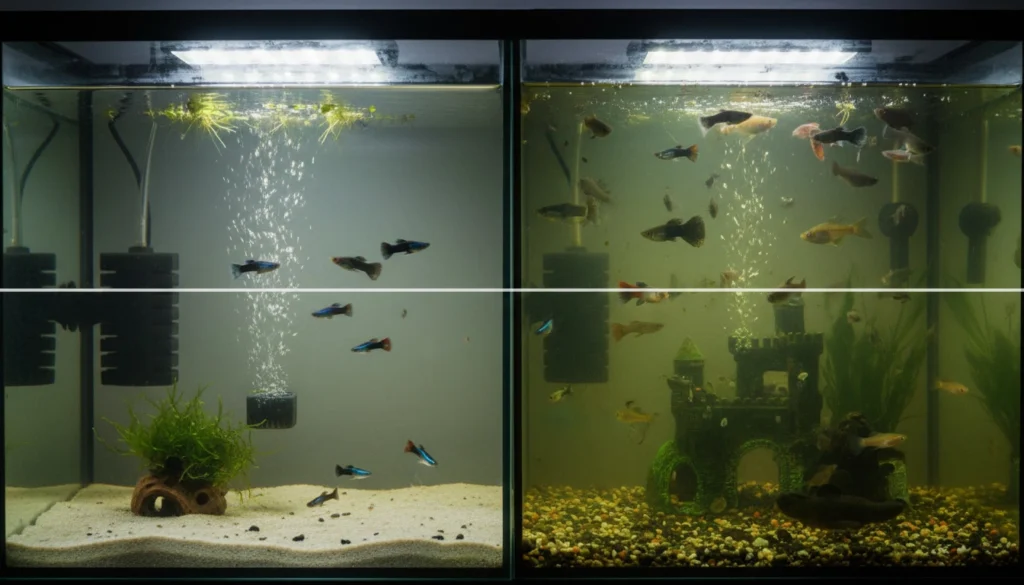
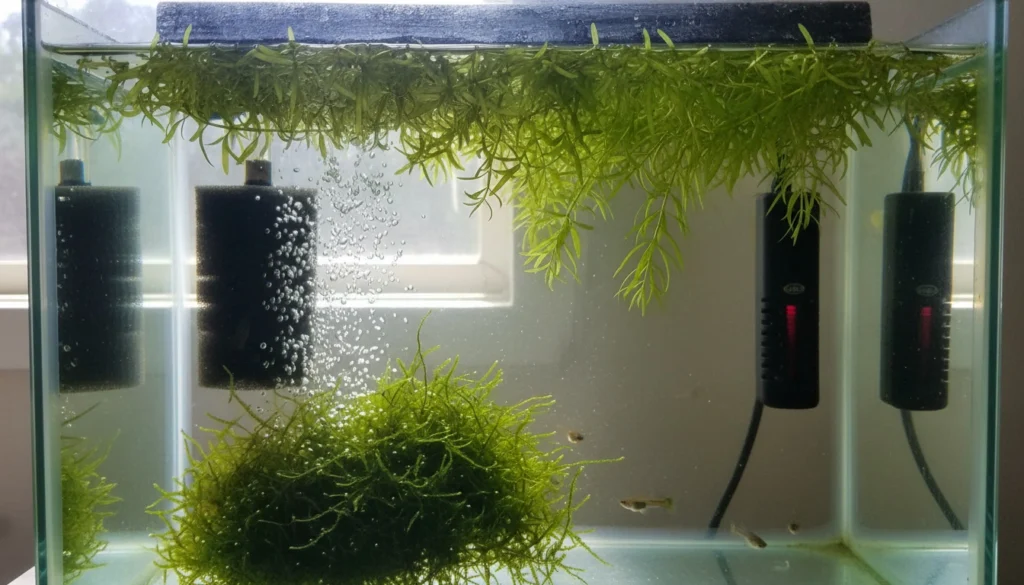
A dedicated breeding tank doesn’t need to be elaborate. My first successful breeding setup was a plain 10-gallon (38-litre) tank with a sponge filter, a heater, and nothing else. No substrate. No decorations. Just clean water at the right temperature, a sponge filter to keep the water healthy without creating suction that would kill fry, and the fish.
The sponge filter is genuinely important here — it deserves emphasis. Standard hang-on-back filters and canister filters create enough intake suction to kill newborn fry. A sponge filter provides biological filtration with zero risk to small fish. If you’re using anything else in a breeding tank, cover the intake with fine mesh.
Plants, Caves, and Hiding Spots — These Are Breeding Triggers, Not Just Décor
I used to think plants were decorative. Then I added a clump of java moss to my guppy breeding tank almost by accident — I had some spare from another tank and tossed it in. My next fry batch was noticeably larger. The batch after that was larger still.
What was happening? Two things. First, the java moss gave newborn fry somewhere to immediately hide and shelter, dramatically reducing the number being eaten before I could separate them. Second — and this is the part I didn’t fully appreciate until later — the presence of dense plant cover reduces breeding inhibition in fish that feel exposed in open water.
For egg-layers, hiding spots serve an additional function: they give females somewhere to retreat after spawning, when males can become territorial and aggressive. Without that refuge, a female may be harassed to the point of injury or death.
Species-specific guidance:
- Guppies: Dense floating plants (hornwort, guppy grass, frogbit) — essential for fry survival
- Bettas: One broad-leaved floating plant (Amazon frogbit, Indian almond leaf) for bubble nest anchoring
- Corydoras and plecos: Caves, coconut shells, or PVC pipe — these are obligate cave spawners; without a suitable cave they simply won’t spawn, full stop
- Cichlids: Flat rocks, clay pots, or leaf litter depending on species
Lighting and Photoperiod — The Cue Most People Never Think About
Fish use light cycles to regulate spawning behaviour. In the wild, longer days signal spring and early wet season — prime breeding time. Shorter days signal the dry season or winter — time to conserve energy.
In your aquarium, a stable photoperiod of 10–12 hours of light per day, followed by consistent darkness, mimics natural conditions that encourage spawning. The easiest way to achieve this is a simple plug-in timer — they cost less than $10 and remove the variability of remembering to turn the light on and off manually.
Diet and Conditioning — The Breeding Secret Most Beginners Miss
Okay — this is the section I wish someone had sat me down and explained properly when I was starting out, because it made more difference than almost anything else I changed.
High-Protein Conditioning Foods
In the wild, fish breed when food is abundant. That abundance — specifically high-protein live food — signals to their body that conditions are right for reproduction. If you’re feeding your breeding fish exclusively on dry flake food, you’re essentially telling their biology that conditions are just… okay. Not exceptional. Not abundant.
Live and frozen foods change that signal completely.
My specific conditioning routine before a breeding attempt:
- Live brine shrimp — fed daily for 2 weeks before introducing breeding pairs. The gold standard. Nothing I’ve tried matches the conditioning effect of live brine shrimp.
- Frozen daphnia — a good alternative when live food isn’t available. Highly digestible, high protein, and most fish take to it immediately.
- Frozen bloodworms — excellent for bettas and larger species, but use sparingly (they’re very rich and can cause digestive issues if overfed)
- Microworms or vinegar eels — perfect for smaller species, and great for conditioning fry to live food from an early age
The change I made that had the single biggest impact on my breeding results was switching from flake food to live brine shrimp as the primary diet for my breeding pairs. Within three weeks, my female guppies were visibly fuller and more active. My male guppies were more persistent in their pursuit. The first fry batch after that switch was the largest I’d ever had.
It sounds almost too straightforward. But conditioning diet is that powerful.
Overfeeding vs. Underfeeding — Both Will Sabotage You
Here’s a counterintuitive one: overfeeding is just as damaging to breeding success as underfeeding. Excess food rots and drives ammonia spikes, which — as we’ve established — shuts down reproductive behaviour entirely. Overweight fish also have lower breeding success; obesity affects egg quality and spawning drive in both sexes.
The right balance: 2–3 small feedings per day, only what the fish can consume in 2–3 minutes per feeding. Remove uneaten food after each session. Keep nitrates in check with regular water changes. That’s the rhythm.
Guppy Not Breeding / Betta Fish Not Breeding — Species-Specific Fixes
Guppy Not Breeding
Guppies are livebearers — meaning females give birth to live, free-swimming fry rather than laying eggs. Under good conditions, a healthy female can deliver anywhere from 20 to 80 fry per batch, with a gestation period of approximately 26–31 days. If your guppies aren’t breeding, here’s the targeted checklist:
Male-to-female ratio: 1 male to 3 females, minimum. Too many males causes female harassment and stress-related breeding failure.
Temperature: 24–26°C. If your tank is sitting below 23°C, this is almost certainly your issue — guppies become sluggish and reproductively inactive in cooler water.
Floating plant cover: Dense surface planting (hornwort, guppy grass, or frogbit) is not optional if you want fry to survive. In a tank without plant cover, a large percentage of newborn fry will be eaten within hours — even by their own parents.
Settling-in time: A newly introduced female may take one or two full gestation cycles before her first successful birth in a new tank. If you’ve had your fish for less than 6 weeks, patience is genuinely part of the equation.
Stress check: Is anything in the tank chasing or fin-nipping at your guppies? Even mild harassment from larger tank mates can suppress reproduction.
What I’ve consistently found is this: guppies are actually quite eager to breed under good conditions. Clean water, correct temperature, the right sex ratio, some live food, and plant cover — in most cases you’ll see results within 4–6 weeks of a proper setup.
Betta Fish Not Breeding
Bettas are a completely different challenge, and I say that as someone who spent the better part of six months figuring out how to breed them successfully.
Bettas are bubble nest builders. The male constructs a floating nest of air bubbles and mucus at the water’s surface, typically anchored to a floating plant or the corner of the tank. The pair spawns beneath it in an elaborate, often aggressive-looking embrace. The male then guards and tends the eggs until they hatch — typically 24–48 hours at 27°C — and continues caring for the free-swimming fry for another 2–3 days before the fry are large enough to be independent.
The most common reason betta breeding fails? The introduction goes wrong.
My first three attempts at introducing a betta pair ended with the female being attacked badly enough to require separation and recovery. Not flaring — actual biting, torn fins, visible distress. I was introducing them the way most forum posts suggested (simply adding the female to the male’s tank) and it was not working.
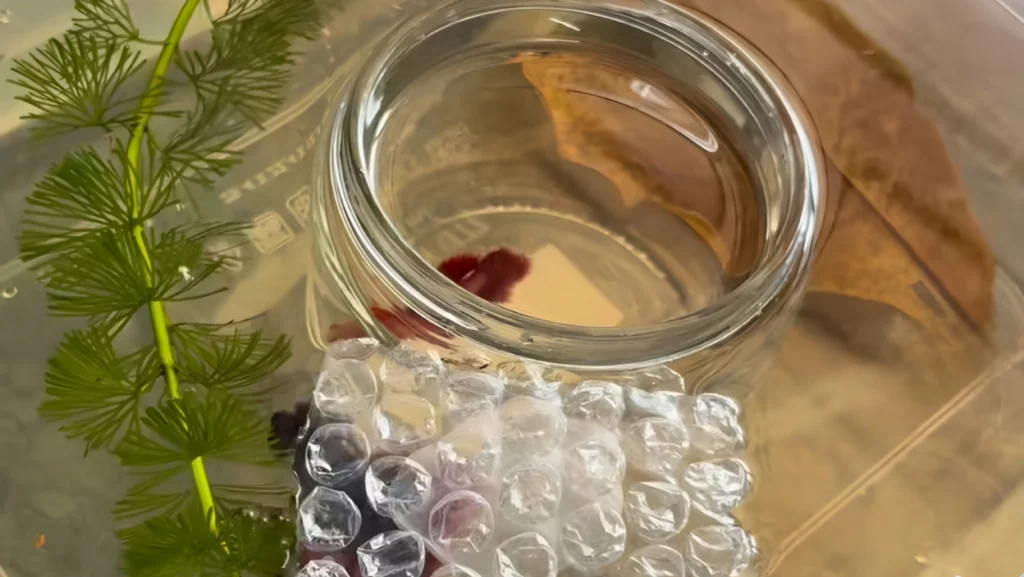
What finally worked was the divider method: I placed the female in a clear plastic container — a cut-down water bottle works perfectly — and floated it inside the male’s tank so they could see each other without physical contact. I left them like that for 4–5 days. During that time, the male built a substantial bubble nest. The female developed a visible white dot on her underside called the ovipositor — the egg-laying tube that appears when a female is ready and conditioned to spawn.
When I removed the divider on day five, the male chased briefly, there was some nipping, but they settled into spawning behaviour within hours. First successful betta spawn. Felt like a genuine victory.
Specific betta breeding requirements:
- Temperature: 27–28°C
- pH: 6.5–7.0
- Water depth: 15–20cm — shallow water makes bubble nest construction easier and reduces the energy cost of retrieving falling eggs
- One broad-leaved floating plant or Indian almond leaf for nest anchoring
- Remove the female immediately after spawning — the male guards the nest and will become aggressive toward her at this stage
- First fry feeding: infusoria or commercial fry food, followed by baby brine shrimp after day 5–7
How to Encourage Fish to Breed — A Practical Action Plan
After three months of zero fry and considerable frustration, the thing that finally changed my results wasn’t any single fix — it was following a systematic process instead of guessing. Once I stopped treating each variable as separate and started addressing everything together, results came within weeks.
Here’s the exact checklist I now use before every breeding attempt.
7-Step Breeding Checklist
- Verify sex and ratio — Confirm you have both sexes in the correct proportion. For guppies: 1 male to 3 females. For bettas: 1 male and 1 female, introduced carefully. Don’t trust the fish shop without verifying yourself.
- Test your water thoroughly — Ammonia: 0 ppm. Nitrite: 0 ppm. Nitrate: below 20 ppm. pH: within species-appropriate range. Temperature: verified with a separate thermometer, not just the heater dial.
- Raise temperature into the upper breeding range — Increase slowly (no more than 1°C per day) to avoid thermal shock. Aim for the upper third of your species’ recommended range.
- Set up a dedicated breeding tank — A basic 10-gallon with a sponge filter is infinitely better than a community setup. Keep it simple, clean, and species-appropriate.
- Add the right cover and spawning structures — Java moss and floating plants for guppies. Floating plant anchor for bettas. Caves or coconut shells for corydoras and cichlids. Match the décor to the species’ natural spawning behaviour.
- Condition your fish for two weeks on live or frozen food — Daily feeding of live brine shrimp, daphnia, or frozen bloodworms. This is the step most beginners skip, and it makes more difference than almost anything else.
- Set a consistent photoperiod — 10–12 hours of light daily using a plug-in timer. Darkness at night is not optional. Consistent light cycles signal breeding readiness in most tropical species.
When It’s Still Not Working — And What to Try Next
If you’ve worked through this checklist genuinely — not just ticked the boxes but actually done each step — and you’re still seeing nothing after 6–8 weeks, here’s what to consider:
- Are your fish actually healthy? Internal parasites and chronic bacterial infections suppress reproduction long before you see visible symptoms. Look for subtle signs: weight loss despite good feeding, slightly clamped fins, reduced activity. A round of treatment with a broad-spectrum internal parasite medication sometimes resolves unexplained breeding failures.
- Are you absolutely certain of the sex? Get a second opinion. Take a clear photo to a reputable online forum (like the Tropical Fish Keeping forum or r/Aquariums) and ask. I’ve seen cases where someone kept two males together for six months convinced one was female.
- Is the species you’re working with genuinely more demanding? Some fish — discus, certain killifish species, wild-caught cichlids — require very precise conditions that go significantly beyond the basics. If you’re a beginner, starting with guppies, danios, or corydoras will build your skill set before you attempt something harder.
- Are your fish simply old? If you bought adult fish of unknown age from a shop, they may be past their prime. This is genuinely a common issue and one that’s easy to overlook.
This may not work for every situation — I want to be honest about that. Some breeding failures come down to factors that are genuinely hard to diagnose without hands-on observation. But in my experience, the checklist above resolves the issue the large majority of the time.
Frequently Asked Questions
Why are my fish not breeding even though I have a male and female?
Having both sexes present is the starting point, not the finish line. The most common culprits in an otherwise-sexed pair are water temperature (too low), water quality (elevated ammonia or nitrate), stress from tank mates or environment, and age. I’d recommend running a full water test first — it’s the quickest way to rule out the most common causes. Also verify temperature with a separate thermometer; heater dials are frequently off by 2–3°C.
How long does it take for aquarium fish to start breeding in a new tank?
For most beginner-friendly species like guppies, expect a 2–6 week acclimation period before breeding activity begins in a new tank. During this window, keep conditions stable, avoid rearranging the tank, and begin conditioning with live or frozen foods in the second week. Stress from the move or new environment can delay breeding even in fish that were previously producing fry regularly.
What’s the best water temperature to encourage breeding?
It depends on the species — there’s no universal answer. Guppies spawn best at 24–26°C (75–79°F). Bettas prefer 26–28°C (79–82°F). Angelfish and zebra danios both do well at 27–29°C. The key insight is that you generally want to be in the upper half of the safe temperature range, not the lower half. A 2–3°C increase within the safe zone can make a significant difference in breeding activity.
Why did my fish stop breeding after they had fry before?
Several possible causes: water quality has degraded (test immediately — elevated nitrates are a common culprit), something in the tank has changed (new fish, rearranged décor, different light schedule), or the female needs recovery time between broods. Female livebearers, in particular, need adequate nutrition and low-stress conditions to cycle between pregnancies efficiently. A water change, some live food, and a week of calm often resolves it.
Can guppies and bettas be kept together for breeding?
Absolutely not — and I want to be unambiguous here. Bettas are aggressive fish that will attack and kill guppies. The long, flowing fins of guppies make them especially attractive targets for betta aggression. Even female bettas can be problematic in a guppy community. Keep bettas in completely separate dedicated tanks. For guppy breeding, choose peaceful tank mates of similar size (small tetras, corydoras, otocinclus) or keep them species-only.
Final Thoughts
Seven years into this hobby, breeding fish still gives me genuine satisfaction in a way that’s hard to describe to someone who hasn’t experienced it. There’s something about the whole process — the conditioning, the setup, the waiting, and then suddenly tiny fry appearing out of nowhere — that never really gets old.
But I remember exactly how disheartening those first few months were. The guesswork. The failed attempts. The fish that just sat there, completely indifferent to all my careful preparation. Looking back, almost every failure came down to a handful of things I now know to fix first: the wrong sex ratio, water that wasn’t quite right, no live food conditioning, and no proper breeding space. Every single one of those is fixable. Usually quickly.
The thing I want you to take from this is simple: your fish are probably not the problem. Healthy fish want to breed. That’s biology. What they need from you is the right environment, the right water, the right food, and a little patience. Get those things right, and most of the time, the rest takes care of itself.
If you see those first tiny fry appear one morning — and you will — you’ll understand why people get so hooked on this hobby.
You’re closer than you think.
| Species | Ideal Temp (°C/°F) | pH Range | Water Hardness (GH) | Breeding Type | Fry/Eggs per Spawn | Gestation/Hatch Time | Min Tank Size |
|---|---|---|---|---|---|---|---|
| Guppy | 24–26°C / 75–79°F | 7.0–8.0 | 10–20 dGH | Livebearer | 20–80 fry | 26–31 days | 10 gal / 38L |
| Betta | 26–28°C / 79–82°F | 6.5–7.0 | 5–10 dGH | Bubble nest | 50–300 eggs | 24–48 hrs | 10 gal / 38L |
| Zebra Danio | 26–28°C / 79–82°F | 6.5–7.5 | 5–15 dGH | Egg scatterer | 100–200 eggs | 48–72 hrs | 10 gal / 38L |
| Angelfish | 27–29°C / 80–84°F | 6.5–7.0 | 3–8 dGH | Substrate spawner | 150–400 eggs | 60 hrs | 30 gal / 114L |
| Corydoras | 22–26°C / 72–79°F | 6.5–7.2 | 2–12 dGH | Egg depositor | 10–30 eggs | 3–5 days | 20 gal / 76L |
| Discus | 28–31°C / 82–88°F | 6.0–6.5 | Below 3 dGH | Substrate spawner | 100–250 eggs | 48–60 hrs | 55 gal / 208L |

KD Sivanath is an aquarium enthusiast with over 7 years of experience in fish keeping and breeding. He specializes in helping beginners learn simple and effective methods for breeding popular aquarium fish. Through this blog, he shares practical tips, real-life experience, and easy-to-follow guides to help anyone start and succeed in fish breeding.