
I remember the first time I set up a guppy tank like it was yesterday. It was a rainy Sunday afternoon, I’d just bought a second-hand 15-gallon tank from a neighbour, and I had absolutely zero idea what I was doing. I threw in some gravel, filled it with tap water, dropped in my six guppies — and within a week, I had thirty tiny fry swimming around with nowhere to hide. No plants. No cover. Nothing.
Half of them didn’t make it.
I know how gutting that feels — especially when you’re new and you don’t even fully understand what went wrong. Was it the water? The other fish? The lack of plants? (It was all three, honestly.) I spent the next few weeks obsessively reading forums, watching videos, and basically haunting every aquarium shop in my area asking questions the staff probably found exhausting.
That was over seven years ago. Since then, I’ve bred hundreds of batches, made every mistake imaginable, and finally figured out what actually works — especially for beginners who want results without spending a fortune or following overly complicated advice.
By the end of this guide, you’ll know exactly how to breed guppies easily at home — even if you’ve never kept fish before.
Why Guppies Are the Perfect Fish to Breed at Home
Let me be honest with you: I didn’t choose guppies because they were fashionable. I chose them because they were cheap, forgiving, and — I’ll admit — absolutely gorgeous. And it turns out those three things make them just about the ideal beginner breeding fish.
There’s a 10-year-old kid in my neighbourhood, Ravi, who breeds guppies in a 10-litre bucket on his balcony and sells them at the local Sunday market. I’m not exaggerating. He makes a small profit, his parents are mildly impressed, and he has more practical knowledge about fish breeding than most adults I’ve met. That’s how accessible this hobby is.
What Makes Guppies Different From Egg-Laying Fish
Most aquarium fish — like tetras, goldfish, and bettas — are egg-layers. They spawn eggs, the male fertilises them externally, and then the hard work begins: you’re trying to keep fragile eggs alive in exactly the right conditions. It’s doable, but honestly, it’s stressful.
Guppies are livebearers, which changes everything. The female carries the fertilised eggs internally and gives birth to live, free-swimming fry. No eggs to accidentally suck up during a water change. No hatching equipment. The babies emerge ready to swim, hide, and eat. That resilience is exactly why guppy fish breeding is so beginner-friendly — the fish have already done most of the hard work by the time you see the fry.
How Fast Do Guppies Reproduce?
This is where people’s jaws usually drop. A single female guppy can give birth to anywhere from 20 to 60 fry every 28 to 35 days. Once she’s been mated, she can actually store sperm for several months — meaning she can produce multiple batches even without a male present. I once separated a female thinking I’d get a break from fry, and three weeks later… surprise.
Do the maths on that. Three females, breeding monthly, averaging 40 fry per batch — that’s 120 new fish a month. You’ll be overwhelmed before you know it. (That’s not a bad thing. Just be prepared.)
Cost of Starting a Guppy Breeding Setup
You don’t need to spend much. Genuinely. When I help beginners set up their first guppy breeding tank, I tell them to budget between $25 and $60 USD for everything:
| Item | Estimated Cost |
|---|---|
| 10–20 gallon tank | $15–$30 |
| Sponge filter | $5–$10 |
| Small heater | $8–$15 |
| Java moss / live plants | $5–$10 |
| Starter guppies (6–10 fish) | $5–$15 |
That’s it. No fancy equipment. No expensive chemicals. Just the basics, done right.
Now that you know why guppies are so popular, let’s talk about where to start — your breeding tank.
Setting Up the Perfect Guppy Breeding Tank at Home
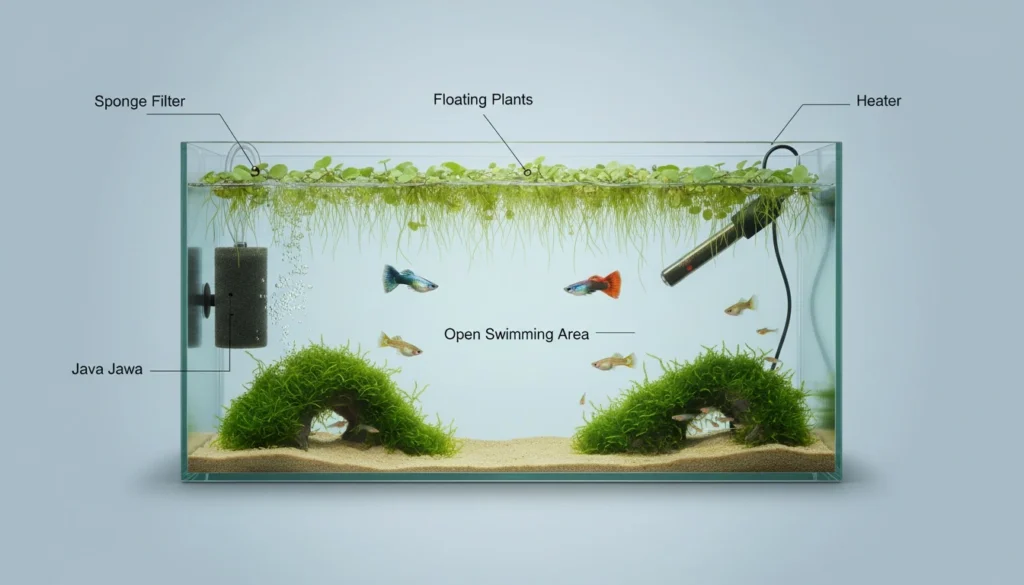
When I built my first proper guppy breeding tank setup — not that chaotic first attempt, but my second, more intentional one — I went with a 10-gallon tank and it was genuinely one of the best decisions I made. It’s the sweet spot: big enough to give the fish space, small enough to manage water quality easily.
You don’t need anything fancy. A 10-gallon does the job beautifully.
Tank Size, Filtration, and Temperature
Tank size: For breeding guppies, a 10 to 20-gallon tank is ideal. Smaller tanks cause stress from overcrowding, which tanks (pun intended) your breeding success. Bigger is fine if you have it, but the 10-gallon is where I’d start every time.
Filtration: Here’s something I wish someone had told me earlier — avoid power filters with strong suction when you have fry in the tank. The intake will hoover up baby fish before you can blink. Use a sponge filter instead. It provides gentle biological filtration, doesn’t harm fry, and doubles as a surface for beneficial bacteria to colonise. A sponge filter rated for a 20-gallon tank in a 10-gallon setup is exactly what you want.
Temperature: Guppies thrive between 24–28°C (75–82°F). Below 20°C (68°F), their metabolism slows, they become lethargic, and breeding almost stops entirely. I keep my tanks at around 26°C — right in the middle — and I’ve found that’s the sweet spot for consistent reproduction and healthy fry development. A reliable submersible heater with a thermostat is worth every penny.
Water parameters: Aim for a pH of 7.0 to 7.5, with moderately hard water (dGH of 8–12). Guppies are surprisingly adaptable, but swinging outside these ranges consistently will stress them out.
Plants and Hiding Spots — Your Secret Weapon
This is the single thing I changed between my first failed attempt and my second successful one. I added plants. Real ones, and floating ones specifically.
Java moss is my absolute go-to. It grows fast, requires almost no care, and creates a dense tangle of cover where fry can hide immediately after birth. The mother — and other adult guppies — will eat fry if given the chance. It’s not personal, it’s just fish instinct. Java moss gives the babies somewhere to disappear into.
Floating plants like frogbit or water lettuce add a canopy of cover near the surface, which is where newborn fry tend to hover. I’ve noticed my fry survival rates went from around 40% to well over 70% just by adding floating plants. That number matters.
Fake plants can work in a pinch, but live plants also help with water quality by absorbing nitrates. Worth the small extra effort.
Male-to-Female Ratio — The Golden Rule
Here’s something a lot of beginners get wrong. More males doesn’t mean more breeding. It means more harassment.
Male guppies are relentless. If there are too many males per female, the females get stressed, stop eating properly, and can actually reabsorb fry or give birth prematurely. The rule I follow — and it works — is one male for every three females (1:3). So in a 10-gallon tank, I’d put 2 males and 6 females. That keeps everyone happy, breeding is consistent, and the females aren’t constantly being chased.
I learned this the hard way after putting 4 males and 2 females together and wondering why my females looked exhausted and my fry count dropped dramatically.
Great — your tank is ready. Now, how do you actually know when your female guppy is pregnant?
Guppy Pregnancy Signs: How to Know She’s About to Give Birth
Once you’ve got a properly set up tank and healthy fish, pregnancy happens fast. Sometimes within a day or two of introducing males. The key is knowing what to look for — because missing the signs means you might not be ready when she gives birth, and unprepared tanks mean lost fry.
Physical Signs of a Pregnant Guppy
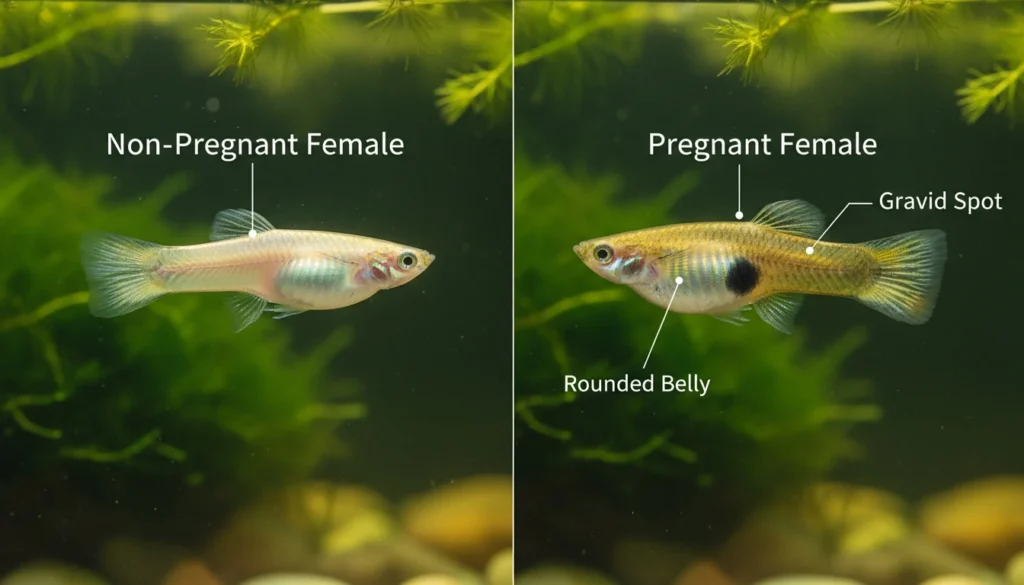
The most reliable indicator is the gravid spot — a dark triangular patch near the base of the female’s tail, just above the anal fin. In young, non-pregnant females, it’s faint or barely visible. As pregnancy progresses and the fry develop, it darkens significantly and expands. In the final few days before birth, it can appear almost black, and you may even see the tiny eyes of the fry through the skin if you look closely in good light.
That used to fascinate me. Still does, honestly.
Beyond the gravid spot, watch for:
- A noticeably rounded, boxy belly — not just plump but squarish, almost like she’s swallowed a marble
- Reduced activity — she may hover near the bottom or a corner of the tank
- Loss of appetite in the final 24–48 hours before birth
- Occasional shimmying or laboured swimming when birth is very close
The Guppy Gestation Period
Guppies carry their fry for 21 to 30 days, depending on water temperature and the individual fish. Warmer water (closer to 28°C) tends to shorten the gestation period. Cooler water slows it down.
Once you notice the gravid spot darkening, start counting. By day 20, I’m checking the tank morning and evening. By day 25, I’ve usually got a separate fry-safe area ready.
When to Separate the Pregnant Female
This is genuinely one of the most common points of confusion for beginners — and honestly, I’ve gone back and forth on it myself.
The traditional advice is to use a breeding box (a small container that hangs inside the tank) to isolate the female before birth. The fry drop through a grate into a protected lower section, away from the mother.
My honest take? Breeding boxes work, but they can stress the female if she’s in there too long. I now prefer to have a heavily planted separate tank or container ready, move her in only when birth is very close (within 24 hours), and return her to the main tank once she’s delivered. Less stress, better outcomes.
She’s given birth — congratulations! But the real challenge begins now. Let’s talk fry survival.
How to Care for Guppy Fry (And Keep Them Alive)
The first time I watched a female give birth I was genuinely mesmerised. These tiny, transparent little creatures appearing one by one, curling and uncurling as they entered the water, immediately swimming upward toward the light. It felt almost miraculous.
And then I watched the mother eat one.
Right. So. These little guys are tough but vulnerable. The instinct to eat their own young isn’t malice — it’s just biology. Guppies don’t recognise their fry as offspring. To them, small moving things are food. Your job is to remove that danger and give the fry the best start possible.
What to Feed Guppy Fry
Newborn guppy fry have tiny mouths, which means they can’t eat regular flake food out of the packet. You need to start small.
Crushed flake food — and I mean really crushed, almost powdered between your fingers — works as a basic staple. I feed this 3–4 times a day in tiny pinches. More frequent small feedings beat one large feeding every time; leftover food rots and tanks water quality fast.
Baby brine shrimp (newly hatched Artemia) are a game-changer for fry growth. They’re living, protein-rich, and the right size. I hatch my own from eggs using a small brine shrimp hatchery — takes about 24 hours — and feed them to fry twice a day for the first two weeks. The difference in growth rate is noticeable.
Micro worms are another brilliant option, especially in the first week. They wriggle in the water column and trigger the fry’s hunting instinct. Easy to culture at home in a small container with oatmeal.
My rough feeding schedule for fry:
- Week 1–2: Micro worms + baby brine shrimp, 3–4x daily
- Week 3–4: Baby brine shrimp + crushed flakes, 3x daily
- Week 5–6: Transitioning to crushed flakes + small daphnia, 2–3x daily
Water Changes for Fry Tanks
Fry are more sensitive to water quality than adults. Ammonia from uneaten food or waste builds up fast in small containers, and even mild spikes can stunt growth or kill fry.
I do small daily water changes of about 10–15% in fry tanks. The trick is using a piece of airline tubing rather than a siphon — it gives you control and you’re far less likely to accidentally suck up a fry. I also make sure the replacement water is the same temperature and has been dechlorinated.
Don’t skip water changes. Seriously. I lost an entire batch of two-week-old fry to a ammonia spike I could have prevented with a simple daily change. It was gutting.
Week-by-Week Fry Development
Here’s roughly what to expect:
- Days 1–7: Fry are tiny (about 6mm), mostly transparent, and spend a lot of time hiding. Survival instinct is strong.
- Week 2: Colour begins to show faintly. They’re more active and feeding more confidently.
- Week 3–4: You’ll start to see males vs females taking shape. Males develop the gonopodium (a modified anal fin) and colour patterns become more distinct.
- Week 5–6: Most fry are now around 1.5–2cm and can be introduced to a community tank — though I prefer to wait until they’re too large to be eaten by adults, usually around 8 weeks.
Common Guppy Breeding Mistakes (And How to Avoid Them)
I made every single one of these mistakes. Every. Single. One. So I’m not writing this from a position of superiority — I’m writing it as someone who’s done the dumb things so you don’t have to.
Overcrowding and Stress
When I was starting out, my instinct was more fish = more fry = more success. Wrong.
Overcrowding creates stress, and stressed guppies breed poorly. They compete for food, oxygen levels drop, and water quality deteriorates much faster. A 10-gallon tank can comfortably support around 10–12 adult guppies — beyond that, you’re pushing it. If you want more fish, set up another tank. Don’t cram them in.
I once had 20 adults in a 10-gallon because I was too lazy to set up a second tank. The males were constantly fighting, the females were stressed, fry counts dropped to single digits, and I lost two females to what I suspect was stress-related illness. Never again.
Ignoring Water Quality
This is the silent killer that wipes out entire batches of fry — and sometimes adults too.
New breeders often focus on fish and forget about water. But your fish are living in that water 24/7. Ammonia and nitrite should always read 0 ppm in an established, cycled tank. Nitrates should stay below 20–40 ppm. I test my water weekly with a liquid test kit (the API Master Test Kit is what I use — the strip tests are less accurate in my experience).
If you haven’t cycled your tank before adding fish, please do that first. The nitrogen cycle takes 4–6 weeks but it’s non-negotiable for fish health.
Not Separating the Fry in Time
Cannibalism is real and it’s brutal. Adult guppies — including the mother — will eat fry without hesitation. I’ve watched it happen in real time, and it doesn’t get easier to see.
If you’re relying on plants alone for fry protection, you’ll save some fry, but not most. For better survival rates, either separate the mother before birth or move fry to a dedicated nursery tank within the first hour of birth. Java moss and floating plants can keep survival rates reasonable (I’ve seen 60–70% in heavily planted tanks), but a separate fry tank is always better.
“Now you know what NOT to do. So what does a healthy, thriving guppy breeding cycle actually look like?”
Scaling Up: What to Do With All Those Baby Guppies
Here’s the thing — you will have more guppies than you expected. It’s almost guaranteed. And that’s actually a good problem to have, once you know what to do with them.
Selling Guppies Locally
This is how Ravi-from-the-balcony funds his entire hobby. Local selling is easier than most people think.
Facebook Marketplace and local community groups are my first recommendation. I’ve sold surplus guppies this way for years — usually listed as “mixed colour guppies, healthy, home-bred” with a decent photo. They go quickly, often within a day.
Local fish stores (LFS) will sometimes buy or trade guppies, though they usually offer store credit rather than cash. Still useful if you’re buying supplies regularly.
Aquarium clubs and hobbyist meets — if there’s one in your area, these are goldmines. Serious hobbyists often pay more for quality, selectively bred fish. Which leads me to…
Selective Breeding for Colour and Pattern
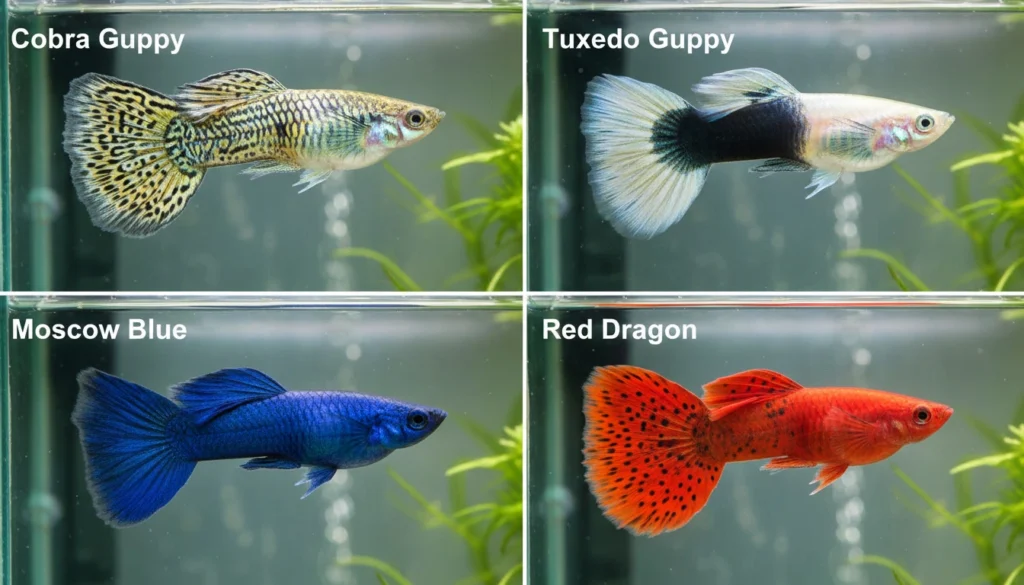
Once you’ve got the basics down, selective breeding is where this hobby gets genuinely exciting. Guppies come in an extraordinary range of colour morphs — cobra, tuxedo, Moscow blue, red dragon, grass, snakeskin — and by selectively pairing fish with the traits you want, you can develop your own line over several generations.
I won’t go deep into this here because it deserves its own guide entirely, but know that this is where many hobbyists spend years. It’s part science, part art, and endlessly satisfying.
Setting Up Multiple Breeding Tanks
When you’re ready to scale, the key is having a clear system:
- A main colony tank for your primary breeding stock
- One or two fry grow-out tanks where fry develop separately by age group
- A quarantine tank for new fish or sick fish
The temptation is to combine everything into one tank to save space. Resist it. Separate tanks mean better control, less disease spread, and much more predictable outcomes. I run four tanks now and it’s genuinely manageable — even with a full-time job.
Frequently Asked Questions About Breeding Guppies at Home
Can I breed guppies in a small tank like 5 gallons? Technically yes, but I’d genuinely discourage it for beginners. Water quality in a 5-gallon tank fluctuates rapidly — one missed water change can spike ammonia and wipe out fry before you notice. A 10-gallon is the minimum I’d recommend for a proper breeding setup. It gives you more buffer and better outcomes.
How many fry will my guppy have in her first pregnancy? First-time mothers typically have fewer fry than experienced ones — usually somewhere between 10 and 30 fry in the first batch. Subsequent pregnancies tend to be larger, with 30–60 becoming common for healthy adult females. Don’t be discouraged if the first batch is small.
Do I need to remove the male after mating? Not necessarily, but it does help with stress management for females. In a heavily planted tank with the correct 1:3 male-to-female ratio, males are manageable. If you notice a specific female being chased obsessively, remove her or the male temporarily to let her recover.
Why are my guppy fry not growing fast enough? Almost always, it comes down to two things: feeding frequency and water quality. Fry need to eat 3–4 times daily — once or twice just isn’t enough. And if ammonia is even slightly elevated, fry growth stalls noticeably. Feed more, change water more frequently, and check your parameters.
How long until guppy fry are old enough to sell? Most buyers want fish that are at least 6–8 weeks old and showing clear colour. At this stage they’re robust, past the most vulnerable window, and visually interesting. Male colour patterns are usually distinct by week 6–8, which makes them far easier to sell.
One Last Thing Before You Set Up That Tank
Seven years in, I still get genuinely excited when I see new fry in a tank. That hasn’t changed. What’s changed is I lose far fewer of them — not because I have better luck, but because I learned from all the mistakes.
You don’t need a perfect setup, expensive equipment, or years of experience to breed guppies successfully. What you need is the right information, a bit of patience, and the willingness to pay attention to your fish. They’ll tell you a lot if you watch them carefully.
Start simple. One tank, a few good quality guppies, java moss, a sponge filter, and a reliable heater. Get those basics right and the rest follows naturally.
If there’s one thing I want you to walk away with from this guide, it’s this: guppy breeding is genuinely one of the most accessible, rewarding, and surprisingly educational hobbies you can get into. You’ll learn about biology, water chemistry, animal behaviour, and patience — sometimes all in one afternoon.
Set up that tank. Make the mistakes. Learn from them. And feel free to share how your first batch goes — I’d genuinely love to hear about it.
— Kd Sivanath

KD Sivanath is an aquarium enthusiast with over 7 years of experience in fish keeping and breeding. He specializes in helping beginners learn simple and effective methods for breeding popular aquarium fish. Through this blog, he shares practical tips, real-life experience, and easy-to-follow guides to help anyone start and succeed in fish breeding.