
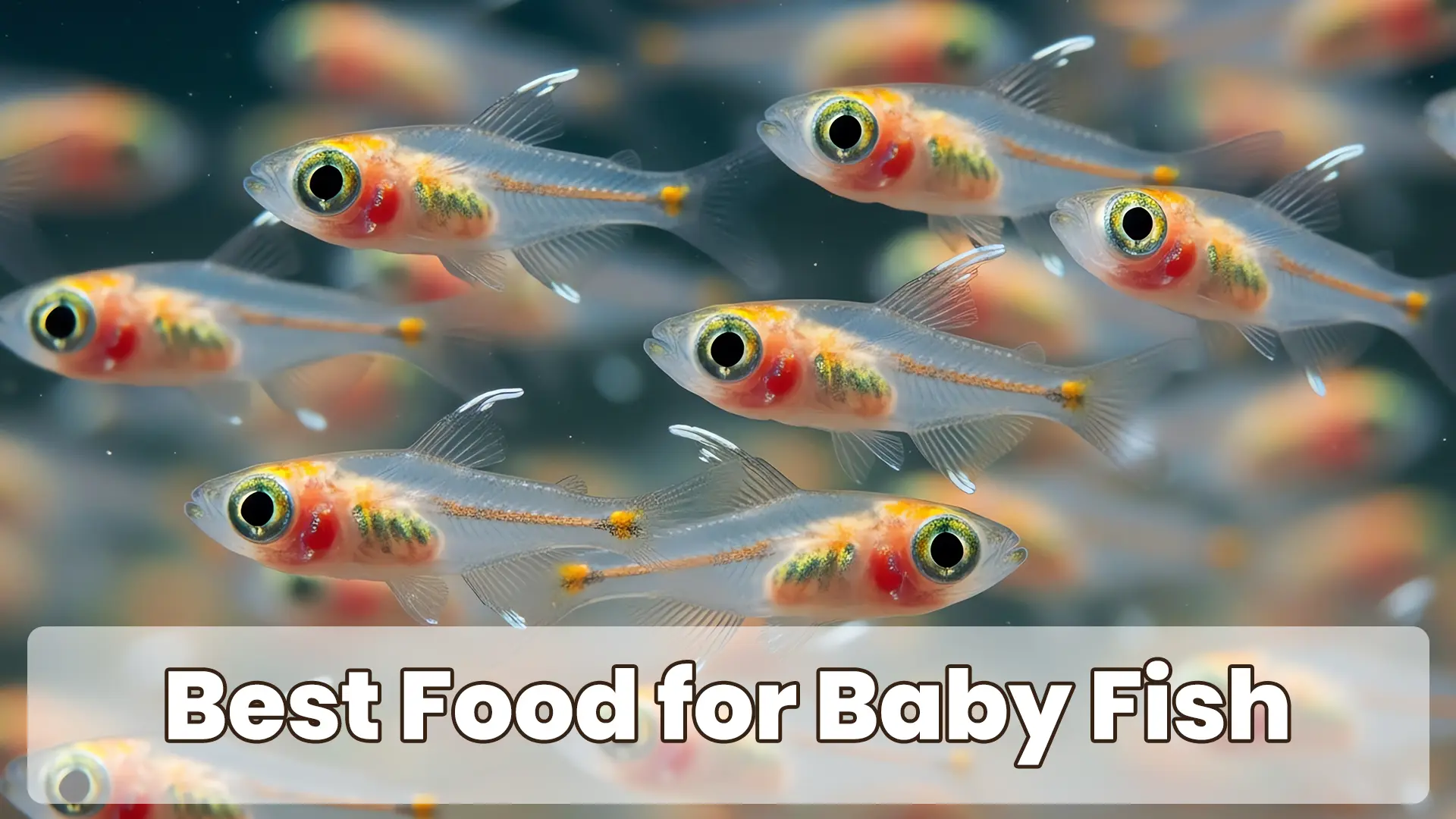
I lost my first batch of guppy fry in three days. Three days. Monday I had a tank full of tiny, perfect little swimmers. Thursday they were gone. I checked the water parameters, I checked the filter, I did everything I thought was right — and I still lost them.
It took me an embarrassingly long time to figure out what went wrong. I was starving them. Not intentionally, obviously. I just had absolutely no idea what baby fish fry actually needed to eat, and nobody had explained it to me in plain terms.
If you’re reading this in a panic because you’ve got fry and you’re not sure what you’re doing — I know exactly how that feels. I’ve been there. More than once, if I’m being honest. By the end of this guide, you’ll know exactly what to feed your fry at every stage of development, how often to feed them, and what mistakes are quietly killing fry in tanks all over the world. The ones I wish someone had warned me about before I learned them the hard way.
Why Fry Food Is Different from Adult Fish Food
Before you grab that adult fish flake and start crushing it between your fingers, let me stop you right there. I know that’s what you’re thinking. I did the exact same thing.
The Tiny Mouth Problem: Size Matters More Than You Think
My first mistake was crushing flakes with my fingers and calling it fry food. It looked like powder to me. To a newborn guppy fry — which is roughly 6 to 7mm long at birth — those “powder” particles were the size of boulders.
Here’s the thing nobody explains clearly enough: fry in their first week need food particles in the 50 to 200 micron range. A single human hair is about 70 microns wide. That’s the scale we’re dealing with. Even fairly aggressively crushed flakes tend to produce particles upward of 300 to 500 microns — two to three times too large for a newborn fry to actually get into its mouth.
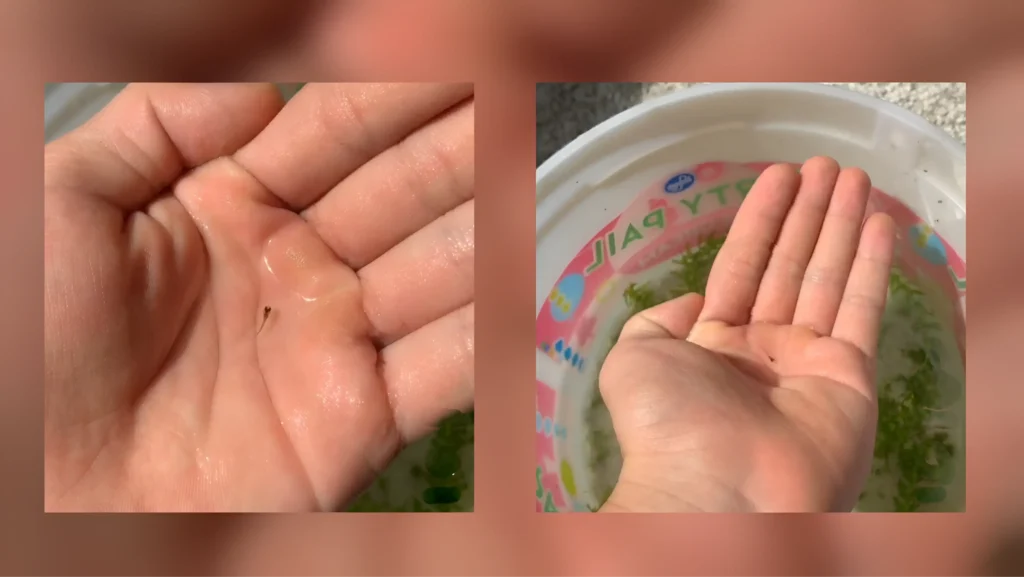
What happens when the food is too big? The fry swim up to it, bump against it, and move away. They’re not being picky. They genuinely cannot eat it. And while you watch them swimming around thinking they’ve had a meal, they’re slowly starving in a tank full of food they can’t access. That was exactly my situation during those three days, and I had no idea.
Nutritional Needs in the First 2 Weeks of Life
Here’s what no one tells beginners clearly enough: for the first 24 to 48 hours after birth, fry are still absorbing the yolk sac they were born with. You don’t actually need to feed them yet during that window. But the moment that yolk sac is absorbed — usually within 24 to 48 hours of birth for most livebearer species like guppies — the clock starts ticking on their first real meal.
And that meal needs to be protein-dense. We’re talking 45 to 55% crude protein content for optimal early growth. Fry are growing at a pace adult fish simply don’t — they need fuel to match that rate. Miss this window with inadequate food and you’ll see stunted growth, lower survival rates, and in some cases physical deformities that become permanent.
In my experience, the single biggest difference between a fry batch that thrives and one that slowly fades is nutrition in those first two weeks. Not disease. Not filtration. Food. Get this right and you’ve won half the battle before it starts.
Now that you understand why fry food is in a completely different category from what you’re feeding the adults, let’s talk about what actually works.
The Best Commercial Foods for Baby Fish Fry Growth
When you’re starting out, commercial fry foods are your most reliable option. The particle sizes are calibrated at the factory, the nutritional profiles are tested, and you’re not guessing. I’ve tried a good number of them over seven years of breeding, and there’s a real difference between the ones worth your money and the ones sitting on the shelf looking impressive.
Hikari First Bites, Sera Micron, and Other Powdered Fry Foods
I’ve used both Hikari and Sera extensively, and here’s what I actually noticed — not what the packaging claims, but what happened in my tanks.
1. Hikari First Bites — This is my top recommendation for most beginners without hesitation. The protein content sits around 50%, the particles are consistently fine enough for livebearers from day one, and guppy fry respond to it immediately. I’ve used it across dozens of batches and my survival rate noticeably improved once I switched from improvised crushed flakes to this. It’s affordable, widely available, and it simply works.
2. Sera Micron — Excellent for very small fry — bettas, some killifish, smaller livebearer varieties. The particles are even finer than Hikari, which makes it genuinely useful for the first three to five days with delicate species. It runs slightly more expensive but earns its price when you’re raising fish whose fry are unusually tiny at birth.
3. New Life Spectrum Fry Starter — Solid nutritional profile, decent protein content, but particle size consistency varies more than I’d like. I use this as a secondary food from around week two onward once the fry have some size on them and aren’t as vulnerable to particle size issues.
4. Tetra Baby Fish Food — Honestly? My personal take is that it’s a bit overhyped relative to price. Not bad, but I’ve seen slower growth compared to Hikari in side-by-side batches. Take that for what it’s worth — one person’s experience, your results may differ.
Liquid Fry Food: Is It Worth the Money?
Liquid fry food — products like Liquifry and similar suspension-based options — always sparks debate in breeding communities. My honest answer: useful in specific situations, unnecessary for most beginners with livebearers.
For very small fry under 5mm at birth — certain killifish species, dwarf cichlid fry, smaller rasboras — liquid food makes a real difference. The particles are so fine they’re essentially suspended in the water column, so fry absorb food just by swimming through it. Genuinely impressive for species that need it.
For guppies, platies, mollies? Skip it if you’ve already got a quality powdered food. The risk — and I’ve done this — is that liquid food clouds your water fast and can spike ammonia within hours of an overly enthusiastic pour. I once turned a perfectly clean 10-gallon fry tank into something resembling diluted pea soup. The emergency water change that followed was not my finest hour.
Fry Food for Guppies Specifically: What Works Best
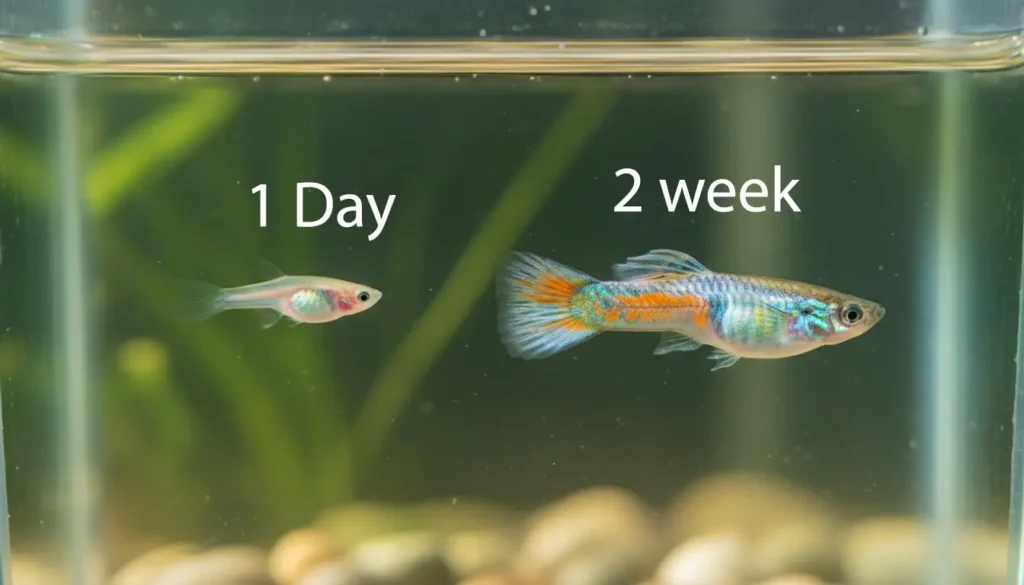
Guppy fry are reasonably hardy compared to some species, but they still have a specific window where food quality determines everything. A well-fed guppy fry at two weeks old should measure roughly 10 to 12mm — noticeably bigger than their 6 to 7mm birth size. If yours are still looking pale and undersized at that point, either the food quality or the feeding frequency needs to change.
The combination that’s worked most consistently for me: Hikari First Bites for the first two weeks, then a gradual introduction of finely crushed high-protein flake alongside it from week three. Once they hit around ten days old, adding baby brine shrimp nauplii (freshly hatched brine shrimp larvae, to explain the term) accelerates growth faster than almost anything else in my experience.
Commercial foods are convenient and reliable — but here’s something most beginners don’t know about what you can make at home for almost nothing.
Homemade Fry Food That Actually Works
This is genuinely one of my favorite things to talk about, partly because it saved me a lot of money when I was starting out, and partly because some of these methods are older than the commercial fry food industry itself.
Hard-Boiled Egg Yolk: The Old-School Trick That Still Works
My grandmother kept fish — goldfish and guppies mostly, in a big tank in her living room — long before any of the commercial fry foods we have today existed. When I was a kid I watched her mash a tiny piece of hard-boiled egg yolk into a jar of water and apply it to the tank with a toothpick. I thought she was a little eccentric, honestly. Turns out she knew exactly what she was doing.
Here’s the proper method:
- Hard boil an egg and let it cool completely.
- Take a piece of yolk smaller than a pea — genuinely, that’s enough for a full fry tank.
- Wrap it in a small square of fine mesh cloth or muslin and swirl it gently in your tank water until you see a fine, milky cloud diffuse into the water.
- Add only what the fry can consume within five minutes.
- Remove all excess immediately — this step is not optional and I cannot stress it enough.
Egg yolk is protein-rich and effective, especially for the first week. The danger is overfeeding — too much egg yolk in a tank and your water quality collapses within hours. I learned this the expensive way. More on that in the mistakes section.
Infusoria, Spirulina Powder, and Daphnia for Tiny Fry
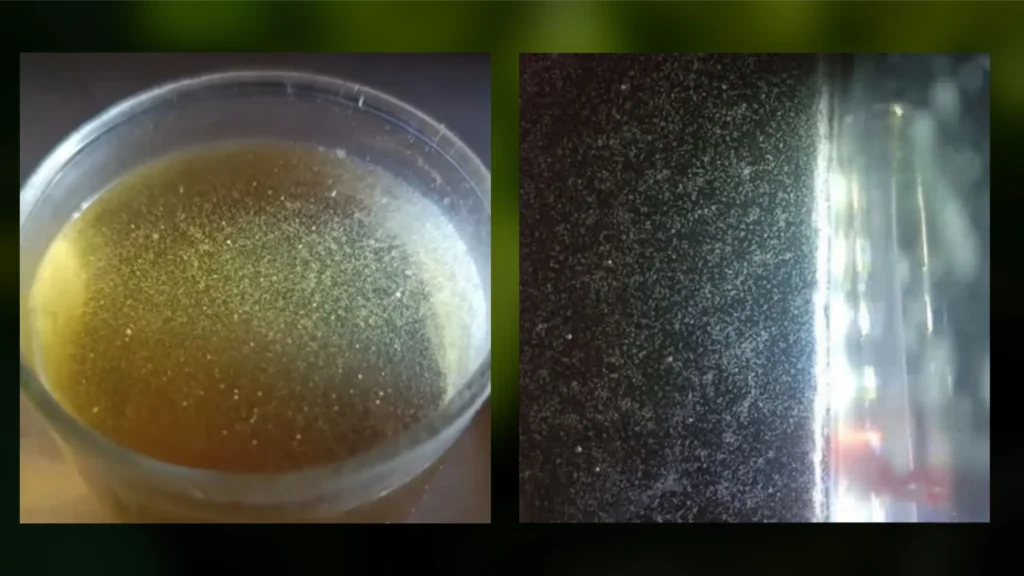
Infusoria — which is a general term for the microscopic organisms like paramecia and rotifers that naturally develop in aged aquarium water — is the closest thing to what fry would eat in their natural environment. And you can culture it at home for nothing.
I grew mine in a jar on my kitchen windowsill. Here’s all you do: take a clean jar, fill it with aquarium water, drop in a small piece of lettuce or some dried grass, and set it in indirect sunlight. After four to five days the water goes slightly cloudy and smells faintly earthy. That’s your culture. Add a few drops to your fry tank daily for the first week.
My partner was not impressed with the jar situation. There were multiple conversations about it. But it worked beautifully for a batch of betta fry that were too small in their first three days for even Sera Micron.
Spirulina powder — a fine blue-green algae powder available cheaply at most health food stores or fish shops — is another easy addition. Mix a tiny pinch into your powdered fry food for a protein and pigment boost. I started doing this around week two and noticed my guppy fry developing color earlier than previous batches.
Baby brine shrimp (BBS) — once your fry are around ten days old and have some size on them, freshly hatched brine shrimp nauplii are the single best live food you can give them. At roughly 400 to 500 microns they’re ideal for fry transitioning off powdered food, and the feeding response is something else — fry that looked calm and disinterested go into what I can only describe as a full feeding frenzy. It’s genuinely exciting to watch.
Great — you’ve got the food sorted. But when and how often do you actually feed them? Because getting that wrong is just as damaging as feeding the wrong thing.
Fish Fry Feeding Schedule: How Often and How Much
This was my exact struggle when I started. I knew I needed to feed them, but nobody gave me a straight answer on frequency. Once a day? Twice? Every hour? The vagueness in most beginner resources drove me slightly crazy.
Week 1–2: The Critical Window (Feed 3–5x Daily)
I set a phone alarm. I’m not joking — I had four separate alarms running during the first week of serious fry rearing. My family had opinions about this. I ignored those opinions and it paid off.
During weeks one and two, feed your fry three to five times per day with very small amounts each time. The rule I follow: add only as much as they’ll eat in five minutes, then remove whatever’s left. A turkey baster works perfectly for this. Here’s the schedule I’ve settled on after years of adjusting:
| Time | Food Type |
|---|---|
| 7:00 AM | Hikari First Bites (powdered) |
| 10:30 AM | Infusoria or liquid food (week 1 only) |
| 1:00 PM | Hikari First Bites (powdered) |
| 5:00 PM | Baby brine shrimp nauplii (week 2+) |
| 8:30 PM | Hikari First Bites (powdered) |
You don’t need to follow this exact timing — what matters is the frequency. Fry have tiny stomachs and fast metabolisms. Space meals too far apart and they’re burning energy just surviving instead of putting it toward growth. That’s how you end up with a batch that technically lived but never really thrived.
Week 3 Onwards: Transitioning to Larger Foods
Around week three, you’ll start seeing your fry develop real size and definition — they start looking like miniature adults rather than larvae. This is when the transition to larger food becomes both possible and necessary.
Signs they’re ready: they’re actively hunting at the surface and mid-column, responding to your approach at the tank, and measuring somewhere in the 12 to 15mm range. They start looking purposeful in their swimming rather than just drifting.
At this stage I introduce finely crushed high-protein adult flakes alongside their regular fry food — not as a replacement, but mixed in at maybe 20% of the meal volume, increasing over the following week. Reducing feeding frequency to two or three times daily is also fine now, since their stomachs can hold more between meals. Don’t make the transition abrupt — gradual is always better with fish.
Feeding right is only half the battle. The other half? Keeping that water clean while doing it — because overfeeding is one of the most common ways people accidentally kill the fry they’re trying to save.
Common Mistakes That Kill Fry (And How to Avoid Them)
Let me be direct here: the majority of fry deaths I’ve witnessed — including in my own tanks — weren’t from disease or bad luck. They were from preventable mistakes. Most of which I made personally before figuring out what was going wrong.
Overfeeding and Water Quality Disasters
I once clouded my tank so badly the fry couldn’t breathe. I’d gotten enthusiastic with egg yolk late one night — added too much, didn’t remove the excess, went to bed feeling good about myself. By morning the water was a milky green color with a smell that I can only describe as deeply unpleasant. About half my fry were gone by the time I ran an emergency water change.
Uneaten food decomposes fast in a fry tank and causes ammonia to spike. Here’s the part that matters: ammonia becomes lethal to fry at concentrations as low as 0.25 ppm — a level that most adult fish would handle without visible distress. Fry don’t have the gill surface area or body mass to buffer ammonia the way adults do. They’re simply more vulnerable, full stop.
My practice now: test the fry tank water every two days during week one using an API Master Test Kit — the liquid drop version, not the strip tests, because strips give unreliable readings in my experience. Ammonia should read zero. Nitrites should read zero. Nitrates should stay under 20 ppm. Small daily water changes of 10 to 15%, with temperature-matched, dechlorinated water, prevent most of these problems before they start.
Wrong Food Size and Nutritional Deficiency Signs
Here’s what I wish someone had shown me early on — what stunted or nutritionally deficient fry actually look like, so you can catch problems before they become permanent.
Watch for these signs:
- Slower than expected growth — a healthy guppy fry should roughly double in length within the first two weeks. Still looking tiny at week two is a red flag.
- Thin or pinched bodies even when you believe you’re feeding adequately
- Curved or bent spine — this condition, sometimes called scoliosis or lordosis in fish, is often nutritional in origin, particularly linked to protein or vitamin C deficiencies in early development
- Dull, faded coloring by week three, when healthy fry should already be starting to show pigmentation
If you notice any of these, switch to higher-quality food immediately, bump feeding frequency, and do a water change. Mild stunting caught early can often still improve significantly.
Quick fix checklist if your fry look wrong:
- Is your food particle size genuinely fine enough for their mouth size?
- Does your fry food label show 45% or higher crude protein?
- Are you feeding a minimum of three times daily?
- Is your ammonia reading zero? If not, overfeeding may be the hidden problem.
- Have you introduced any live food — infusoria or baby brine shrimp?
Now let’s tie it all together — here’s my personal fry growth checklist built from seven years of getting some things right and a lot of things wrong first.
Fry Growth Tips: My Personal Checklist for Fast, Healthy Results
After breeding guppies, platies, mollies, bettas, and a few other species I probably shouldn’t have attempted as a complete beginner — I’ve landed on a set of practices that reliably produce healthy, fast-growing fry. These aren’t theories. They’re what I actually do.
Food + Water + Space: The Growth Triangle
Fast fry growth comes down to three things: food quality, water quality, and enough space. Let any one of these slip consistently and the other two can’t fully compensate. I’ve tested this more times than I’d like to admit.
Here’s the checklist:
- Have the right food ready before the fry arrive. Don’t improvise after birth. If you see a pregnant female getting close, have powdered fry food in the house that day.
- Feed three to five times daily for weeks one and two. Small amounts, every session. Set alarms if you need to.
- Introduce baby brine shrimp by day ten. Nothing accelerates guppy fry growth faster in my experience. Nothing.
- Do 10 to 15% water changes every one to two days. Stability matters more than perfection, but small consistent changes beat infrequent large ones every time.
- Keep fry tank water at 78 to 80°F (25 to 27°C). Warmer water speeds metabolism in tropical livebearers and measurably improves growth rate.
- Keep density reasonable — no more than 20 to 25 fry per 10 gallons. Overcrowding stunts growth and increases disease pressure as they develop.
- Use a sponge filter, not a hang-on-back. HOB filters will suck small fry in. A simple air-driven sponge filter keeps water clean without becoming a hazard.
- Remove uneaten food within ten minutes of every feeding. Turkey baster. Thirty seconds of work that protects your water quality for the next 24 hours.
- Photograph your fry against a ruler weekly. Sounds excessive, I know. But catching a growth slowdown in week two is much easier to fix than catching it in week four.
This list may not work identically for every species — betta fry, for example, require infusoria before they can handle anything larger, and they need the infusoria-only phase for the first three to five days specifically. But for livebearers generally, this is the framework I come back to every time.
Frequently Asked Questions About Baby Fish Fry Food
What is the best food for newborn fish fry right after birth?
For the first 24 to 48 hours, fry are still absorbing their yolk sac and don’t need feeding yet — adding food at this stage just pollutes your water unnecessarily. Once the yolk sac is absorbed, start with infusoria or a quality powdered food with particles under 200 microns, like Hikari First Bites. For very small fry under 5mm, liquid fry food or a strong infusoria culture is the better first option.
How often should I feed guppy fry?
Three to five small feedings per day during weeks one and two. By week three, two to three feedings is adequate as their stomachs grow and can hold more between meals. What matters most is consistency — missing feedings in week one has a disproportionate impact on final growth because of how rapidly fry develop in that window.
Can I feed baby fish crushed adult flakes?
Only as a very short-term emergency option if you genuinely have nothing else. Even aggressively crushed flakes often produce particles in the 300 to 500 micron range — too large for most newborn fry. Adult flakes also typically run lower in protein than dedicated fry food. Get proper fry food as quickly as you can; those first two weeks are too important to improvise through indefinitely.
Why are my fry dying even though I’m feeding them?
Almost always one of three things: overfeeding has caused an ammonia spike (test your water — 0.25 ppm is already lethal to fry), the food particles are too large for them to actually eat despite your best efforts, or you’re feeding infrequently enough that they’re starving between meals. Check ammonia first. If that’s clean, look at your food particle size and your daily feeding schedule.
How long does it take guppy fry to reach adult size?
With consistent feeding and warm water around 78 to 80°F, guppy fry typically reach near-adult size in three to four months. Well-fed batches in optimal water conditions sometimes start looking like small adults as early as ten weeks. Temperature and protein intake are the two biggest variables — get both right and growth happens faster than most beginners expect.
Your Fry Deserve the Best Start — And Now You Know How to Give It to Them
Seven years ago I sat next to a tank that had been full of guppy fry three days earlier, feeling genuinely terrible about what I’d allowed to happen without even understanding what I’d done wrong. I didn’t know about particle size. I didn’t know about feeding frequency. I thought fish were simple.
They’re not simple — but they’re also not as complicated as those panicked early days make them feel. What I want you to walk away with today is this: the food decisions you make in those first two weeks matter more than almost anything else in your fry’s development. Get the particle size right. Get the protein content right. Feed often and clean up after each meal. Keep the water stable. Everything else can be adjusted as you go.
Your fry deserve the best start, and now you know exactly how to give it to them.
If this helped you, I’d genuinely love to hear how your batch is going — drop a comment below and tell me what species you’re raising. And if you want more guides like this one, written from real breeding experience rather than generic advice, there’s plenty more on the blog. Good luck out there.

KD Sivanath is an aquarium enthusiast with over 7 years of experience in fish keeping and breeding. He specializes in helping beginners learn simple and effective methods for breeding popular aquarium fish. Through this blog, he shares practical tips, real-life experience, and easy-to-follow guides to help anyone start and succeed in fish breeding.