
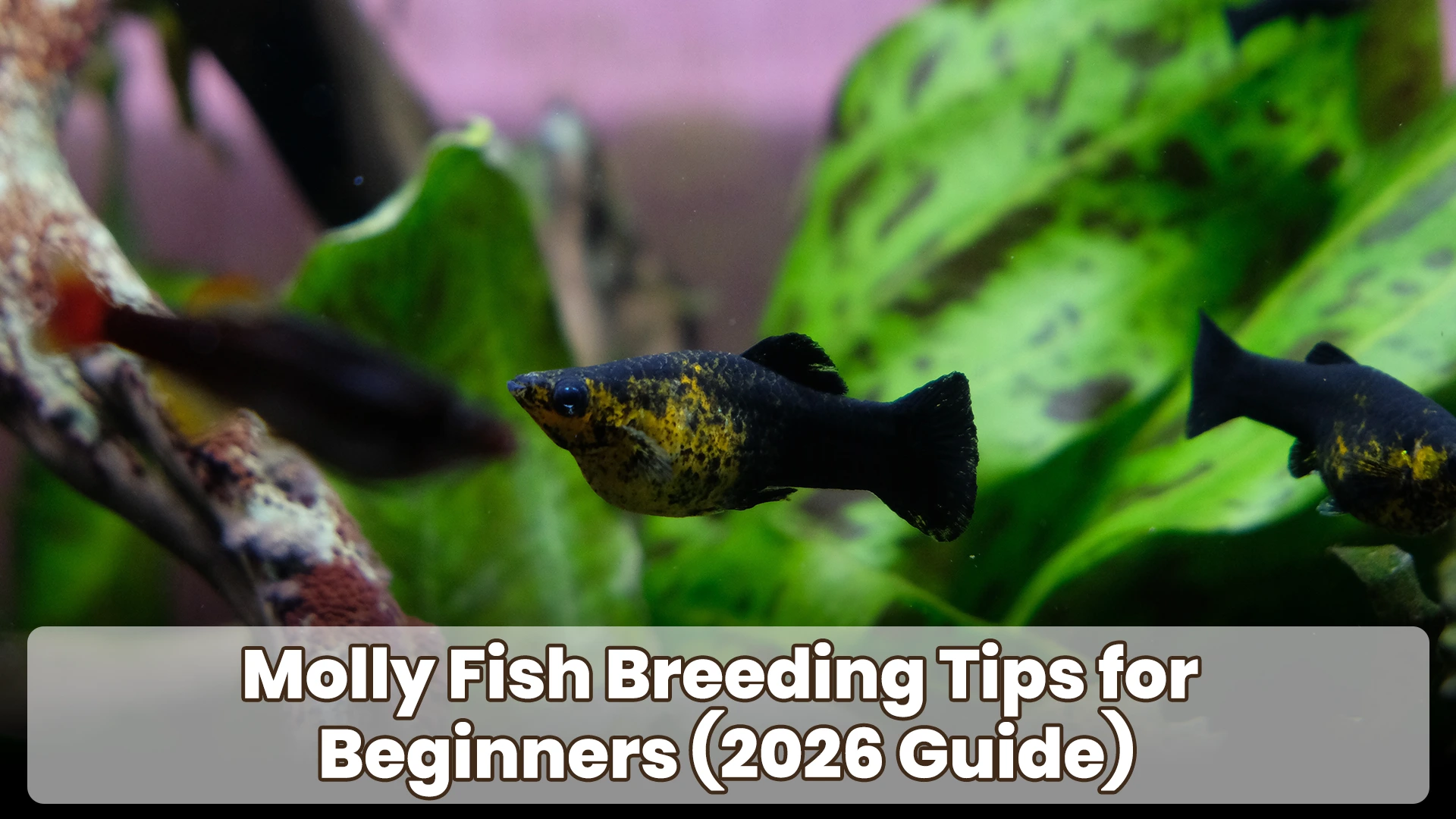
Molly fish are one of the easiest freshwater species for a beginner to breed successfully — they’re livebearers, which means the female gives birth to free-swimming babies instead of laying eggs that need incubating. No breeding triggers, no temperature tricks, no guesswork about fertilization. If you’ve got a healthy male and female molly sharing a tank, breeding will likely happen on its own, often sooner than you expect.
I’ve been keeping and breeding livebearers for over seven years now, and mollies were actually the fish that got me hooked on breeding in the first place. I still remember the night it happened to me — it was close to 2 AM, I couldn’t sleep, and I wandered over to check the tank purely out of habit. Stuck against the filter intake was a tiny orange fry, barely moving. My molly had given birth hours earlier, and I hadn’t noticed until half the fry were already scattered around the tank in places I never thought to check.
I didn’t sleep much the rest of that night.
If one of your mollies suddenly looks rounder, slower, or more withdrawn than usual, you’re probably asking the same questions I was — is she pregnant, or just bloated? Is something wrong? That confusion is completely normal, especially with so much conflicting advice online. This guide will walk you through setting up a proper breeding tank, recognizing real pregnancy signs, and — the part most beginners get wrong — actually keeping the fry alive once they arrive.
What Makes Molly Fish Breeding So Beginner-Friendly?
Mollies don’t need much convincing to breed. As livebearers, females carry fertilized eggs internally and give birth to fully-formed, free-swimming fry that can eat and hide from day one. There’s no egg incubation stage to monitor, and no risk of a fungal infection wiping out an entire clutch overnight — which is a real problem egg-laying species can face.
A friend of mine spent nearly eight months trying to breed neon tetras before giving up out of frustration. Soft water, dim lighting, simulated rain — none of it worked reliably. She picked up a few mollies almost as an afterthought and had fry within two weeks. That contrast is fairly typical — livebearers generally reward beginners much faster than egg-scattering species do.
What tends to surprise new breeders most isn’t how hard breeding is — it’s how little effort it actually requires. Under normal, stable community tank conditions, mollies will often breed whether you’re trying to or not.
Once you understand why mollies breed so easily, the next question is — how do you actually prepare for it?
Molly Fish Tank Setup for Breeding Success
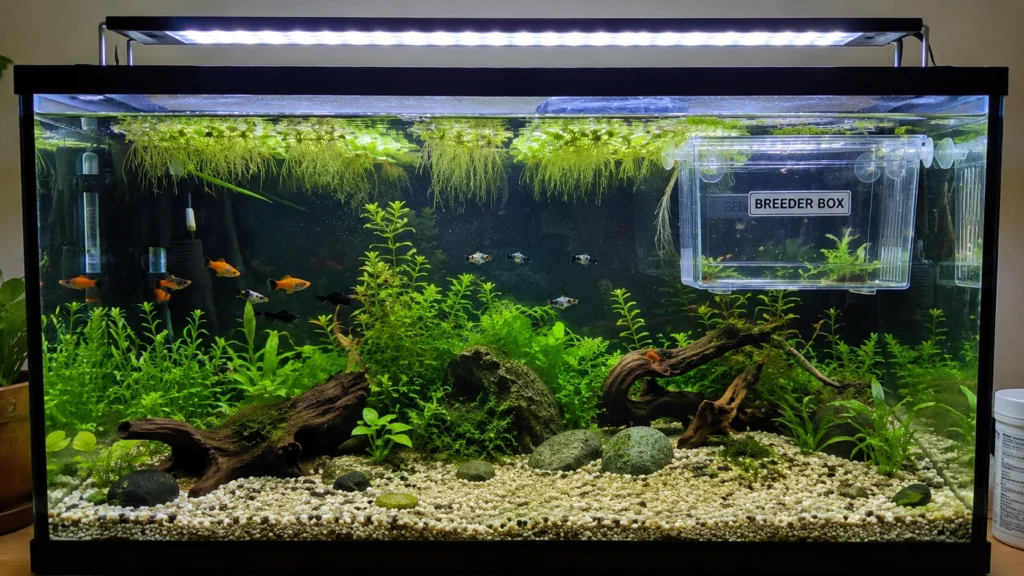
You don’t need anything elaborate, but a few details genuinely matter.
For a dedicated breeding setup, aim for at least a 10-gallon tank, though 20 gallons gives adults and fry more room to avoid each other — which matters more than most beginners realize. Water temperature should generally stay between 72°F and 78°F (22°C to 26°C), with a pH range of 7.5 to 8.5, since mollies prefer slightly harder, more alkaline water than many other community fish.
Dense floating or bushy plants — hornwort, java moss, water sprite — give newborn fry somewhere to hide immediately after birth. This is one of the biggest survival factors, and I’ll come back to why later. Breeder boxes or breeder nets can help too, though I have mixed feelings about them for anything beyond the final day or two before birth, since cramped spaces can stress an already-pregnant female.
For ratios, one male to two or three females tends to work best. Early on, I kept a single male with just one female in a small tank, and she was constantly harassed — chased, no rest, barely eating. Males can be relentless when there’s nowhere for a female to retreat to, so spreading that attention across more females usually makes for a calmer, healthier tank overall.
With the tank ready, it’s time to talk about the moment every breeder is watching for — pregnancy.
How to Tell If Your Molly Fish Is Pregnant
This is where I made my most common early mistake, so hopefully I can save you some time here.
The clearest indicator is the gravid spot — a dark patch near the female’s rear underside, close to the anal fin. As pregnancy progresses, this spot typically darkens, and her belly develops a distinctly squared-off, boxy shape rather than just looking generally round. That last detail is the one I missed the first time — I saw a full belly and assumed pregnancy, when she was really just overfed. A soft, round belly is often just weight. A firm, square belly with a dark gravid spot is usually the real sign.
Behaviorally, pregnant females often become more reclusive, tucking into plants or corners, and may show occasional twitching or restlessness as birth approaches — sometimes mistaken for illness, but usually just late-stage discomfort.
Gestation length varies more than a lot of guides admit. Most sources put molly pregnancy somewhere between 30 and 60 days, with some fancy varieties (like Dalmatian mollies) occasionally stretching closer to 70 days. Warmer water within the safe range tends to shorten gestation slightly, while cooler water can extend it. In the final week, you’ll usually notice reduced appetite, more hiding, and that gravid spot deepening toward black.
Spotting pregnancy is only half the process. What happens right before and during birth matters just as much.
Molly Fish Breeding Tips: What to Do Before and During Birth
Here’s what I actually do now, after a fair bit of trial and error.
About a week before her expected due date, I move the female into a separate breeding tank, or a breeder box for just the final 24 to 48 hours. I’ll be honest — I’m not a big fan of leaving fish in breeder boxes long-term, since the confined space can add stress. But for that short final window, it does help protect the fry from being eaten the moment they’re born.
In those last few days, keep disturbances to a minimum — dim the lighting, skip water parameter changes, and avoid rearranging the tank. This isn’t the week to experiment.
I’ve watched a full birth start to finish, and it’s genuinely fascinating. The process can take one to several hours. The female goes still, curls slightly, and fry appear one at a time, dropping and immediately swimming for cover. A single molly typically releases 20 to 60 fry per birth, though larger, well-fed females have been known to produce upward of 100. That range still surprises me — it depends heavily on the mother’s age, size, and overall health.
Labor itself looks subtle rather than dramatic — periods of stillness followed by a fry appearing. If you don’t know what to look for, it’s easy to miss entirely, which is exactly what happened to me that first time.
The babies are here — now comes the part most beginners get wrong: keeping them alive.
Molly Fish Fry Care — Keeping Babies Alive
That fry stuck in my filter intake happened because I hadn’t separated the newborns fast enough. By the time I noticed, a few had already been pulled toward the filter or eaten by tankmates. It’s a mistake I only needed to make once.
Separating fry from adults isn’t optional if survival matters to you — it’s the single biggest factor in how many babies make it past the first few weeks. Adult mollies, including the mother, will often eat their own fry given the opportunity. It’s instinct, not malice, but it’s still hard to watch happen. Move fry to a separate rearing tank or a well-planted breeder net as soon as you spot them.
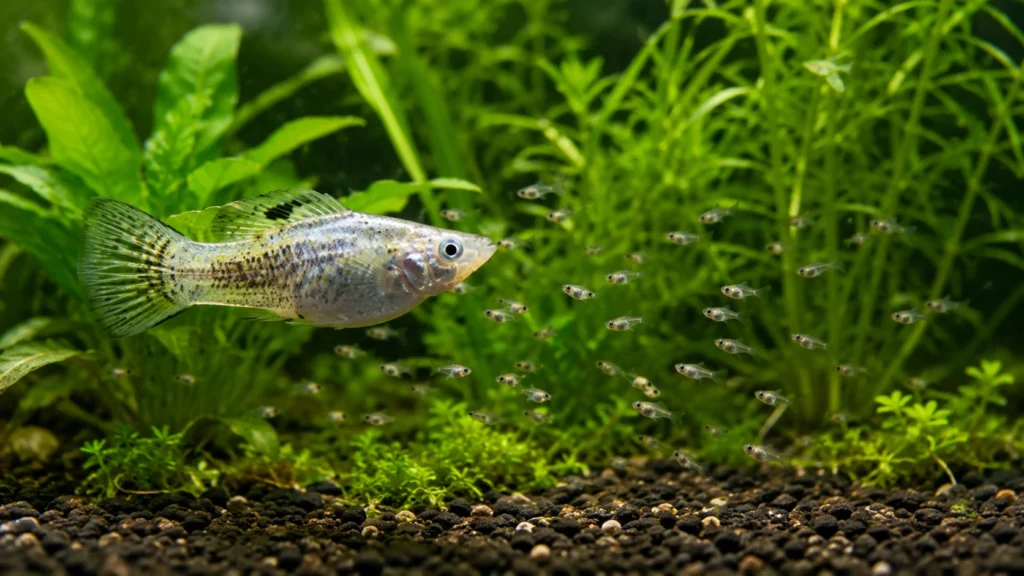
For feeding, newborn fry need food small enough to actually eat. Finely crushed flake food, baby brine shrimp, or infusoria all work well in the first couple of weeks. I feed fry 3 to 4 small meals a day rather than one large feeding — their stomachs are tiny, and frequent small meals generally support faster, more even growth.
Water quality matters even more in a fry tank than in a standard setup. I typically do 20% water changes every 2 to 3 days, since ammonia builds up quickly with that feeding frequency, and fry tolerate poor water far less than adults do. With consistent separation, feeding, and water changes, survival rates can often reach 70% to 80%; without them, that number can drop well below 20%.
If you’re setting up a rearing tank for the first time, it’s worth reading a proper fish fry food guide before the fry actually arrive, so you’re not scrambling on day one.
Even with solid care, a few recurring challenges trip up most beginners. Let’s go through the ones I get asked about most.
Common Molly Fish Breeding Mistakes to Avoid
I’ve made most of these myself, so think of this as a shortcut past my own learning curve.
Overfeeding and poor water quality tends to top the list. It’s tempting to feed heavily when you’re excited about new fry, but excess food breaks down fast and spikes ammonia — especially in a smaller rearing tank. Checking your aquarium water parameters regularly rather than guessing makes a real difference here.
Waiting too long to separate fry from adults is mistake I made in my very first breeding attempt. I told myself “I’ll do it tomorrow,” and lost close to half a batch overnight. In most cases, same-day separation is worth the extra effort.
Ignoring an overly aggressive male rounds out the common issues. Constant chasing stresses females, damages fins, and can reduce breeding success over time. If you notice one male dominating, adding more females or separating him temporarily usually helps.
Once these are under control, you’re in a good position to grow your molly colony with more confidence.
Final Molly Fish Breeding Guide Tips for Long-Term Success
A few things I wish I’d known earlier.
If you’re breeding seriously, it helps to track generations. Breeding closely related fish repeatedly can weaken a line over time — smaller fry, more deformities, lower survival rates. Introducing new, unrelated stock every couple of generations generally keeps things healthier. This is a common issue across most livebearer fish species, not just mollies.
Scale up gradually rather than jumping straight from one small tank into a full breeding operation. I added tanks one at a time over roughly a year, learning each setup’s quirks before expanding further.
Eventually, you’ll likely have more fry than you know what to do with — a good problem to have. Many local fish stores will take healthy, well-raised mollies, sometimes in exchange for store credit.
That tank from the story at the start — the one with the fry stuck in the filter — now runs three generations deep, all descended from that first unexpected litter.
| Molly Fish Breeding Snapshot | Detail |
|---|---|
| Tank size (minimum) | 10 gallons (20+ recommended) |
| Water temperature | 72°F–78°F (22°C–26°C) |
| pH range | 7.5–8.5 |
| Gestation period | 30–60 days (up to 70 in some varieties) |
| Fry per birth | 20–60 (up to 100+ in larger females) |
| Fry survival rate (with proper care) | 70–80% |
Frequently Asked Questions
How long are molly fish pregnant? Molly gestation typically runs 30 to 60 days, though some varieties, like Dalmatian mollies, can stretch closer to 70 days. Warmer water within a safe range tends to shorten this slightly.
How many fry do mollies have at once? Most mollies release between 20 and 60 fry per birth, though larger, well-fed females can produce over 100. Age, size, and overall health all influence the number.
Do molly fish eat their babies? Yes, this is common and instinctual rather than aggressive behavior. It’s exactly why separating fry immediately after birth is so important for survival.
Can I breed mollies in a community tank? You can, but fry survival rates tend to drop significantly without separation — often below 20% — since tankmates and even the parents will eat them. A dedicated breeding or rearing tank is generally more reliable.
What do molly fry eat first? Finely crushed flake food, baby brine shrimp, or infusoria all work well in the first week or two. Feeding 3 to 4 small meals daily tends to support steadier growth than one large feeding.
Final Thoughts
Looking back at that 2 AM scramble over a single fry in a filter intake, it’s strange to think how far that tank has come since. I didn’t know what I was doing then — I was reading conflicting forum threads at midnight, second-guessing every decision I made.
What years of doing this has taught me is that molly breeding rewards patience far more than expertise. You don’t need advanced equipment or a decade of experience — you need a decent tank, attention to a few key details, and the willingness to learn from whatever goes wrong along the way, because something usually will.
If there’s one thing worth taking from this guide, it’s this: don’t wait for perfect conditions before you start. Set the tank up, watch closely, and trust that you’ll figure out the rest as you go — because that’s exactly how most of us learned, myself included.

KD Sivanath is an aquarium enthusiast with over 7 years of experience in fish keeping and breeding. He specializes in helping beginners learn simple and effective methods for breeding popular aquarium fish. Through this blog, he shares practical tips, real-life experience, and easy-to-follow guides to help anyone start and succeed in fish breeding.