
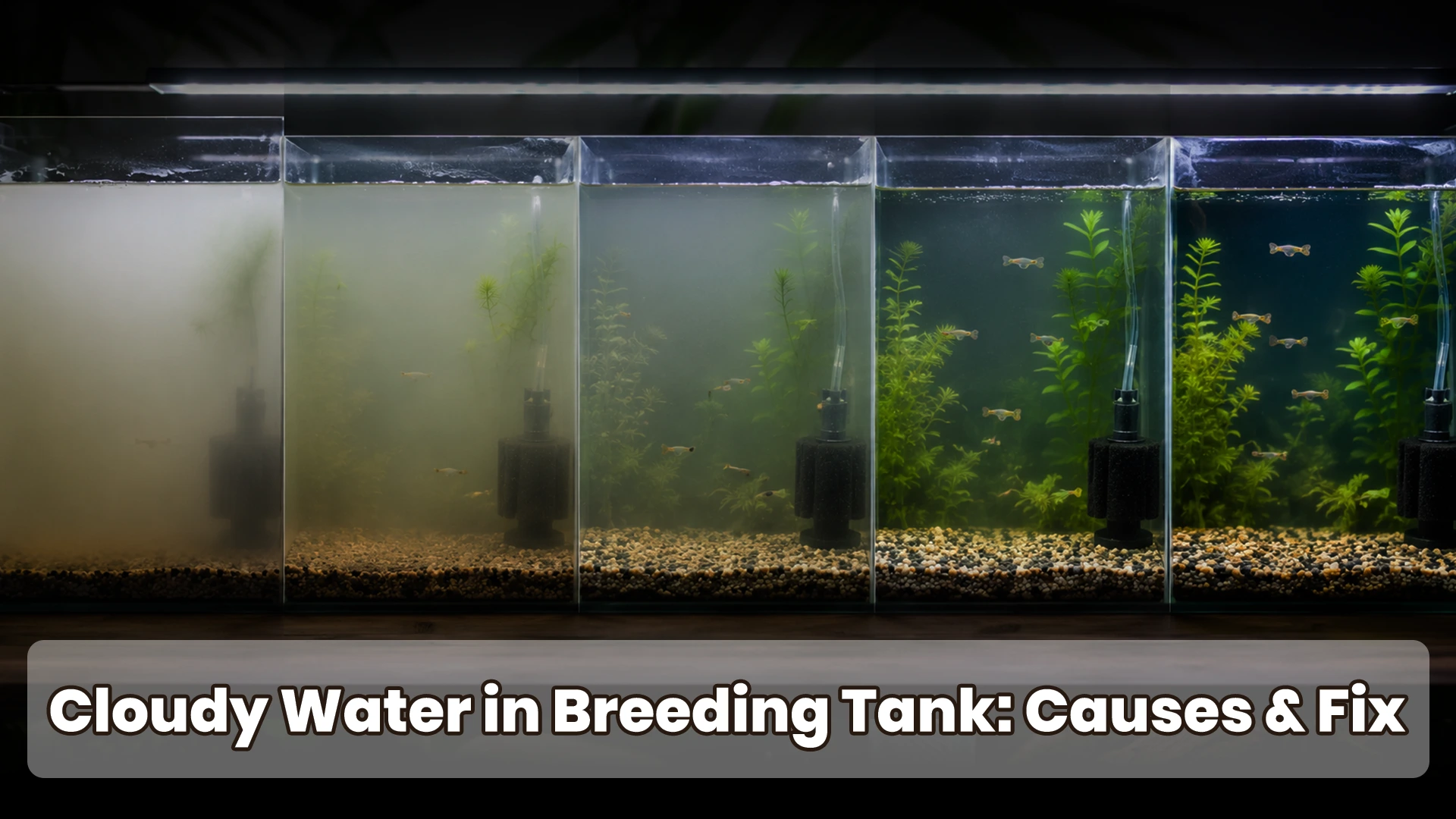
Cloudy water shows up in breeding tanks far more often than in regular display tanks, and there’s a simple reason for that. Breeding tanks run on smaller volumes, get fed more frequently because fry need multiple feedings a day, and usually rely on gentle filtration like sponge filters that don’t process waste as aggressively as a canister or HOB unit would. Add a bacteria colony that hasn’t fully established yet, and you’ve got the exact recipe for a tank that looks like skim milk got poured into it overnight. Most of the time it’s not dangerous. Sometimes it is. Knowing which one you’re looking at is the whole game.
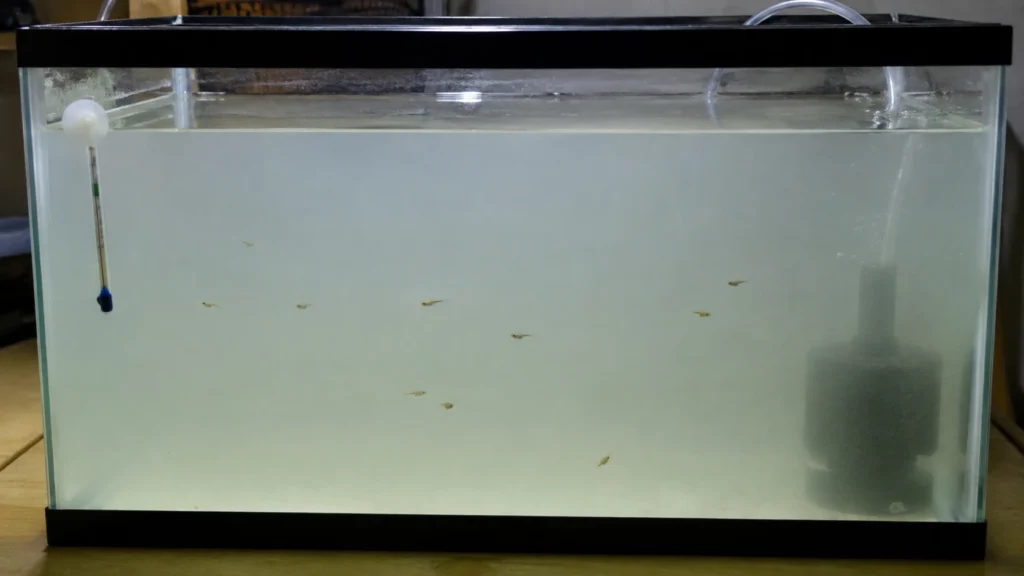
I didn’t understand any of this the first time it happened to me, seven years ago, with a batch of Guppy fry I was more nervous about than I probably needed to be. What happened over the next 48 hours taught me more about breeding tank chemistry than the previous two years combined.
The Morning I Thought I’d Lost the Whole Fry Batch
It was the second week into a Guppy fry batch — around eighteen fry, give or take, in a bare-bottom 10-gallon I’d set up specifically for breeding. I remember the number because I’d counted them twice the day before, proud of myself for a decent hatch rate. I did a routine 20% water change that evening, nothing unusual, something I’d done a dozen times on other tanks without a second thought.
By the next morning, the water wasn’t just slightly hazy. It was properly white, almost grey, thick enough that I couldn’t see the fry unless they swam right up against the glass. My stomach dropped a little, if I’m honest. My first thought wasn’t “bacterial bloom.” My first thought was that I’d somehow poisoned the whole tank overnight.
I stood there for a good few minutes just staring at it, running through what I’d changed — new water conditioner batch, slightly warmer tap water than usual, a pinch more food the night before because I’d been paranoid about underfeeding. I didn’t touch anything. I didn’t do another water change out of panic, which, looking back, was the one thing I got right by accident rather than by knowing better.
It took me until that afternoon, after testing the water and seeing zero ammonia, to actually understand what I was looking at.
What Cloudy Water Actually Is (Not All Cloudiness Is the Same)
That zero-ammonia reading was what saved me from doing something stupid. Once I calmed down enough to actually think, I realized I’d been lumping every kind of cloudy water into one category in my head, and that’s a mistake I still see beginners make constantly in breeding forums.
There are really three distinct types, and once you’ve seen each one a few times, you stop confusing them. Bacterial bloom looks like what I had that morning — a uniform white or pale grey haze, almost milky, and it tends to appear suddenly, usually within 12 to 24 hours of a water change or a feeding increase. Green water is a different animal entirely; it’s caused by suspended algae rather than bacteria, and it builds up gradually over days rather than overnight, with a distinct green or olive tint you can’t mistake for anything else. Then there’s particulate cloudiness, which is just physical debris — uneaten food, substrate dust, or waste — suspended in the water column, and this one usually settles within a few hours if you leave the tank alone.
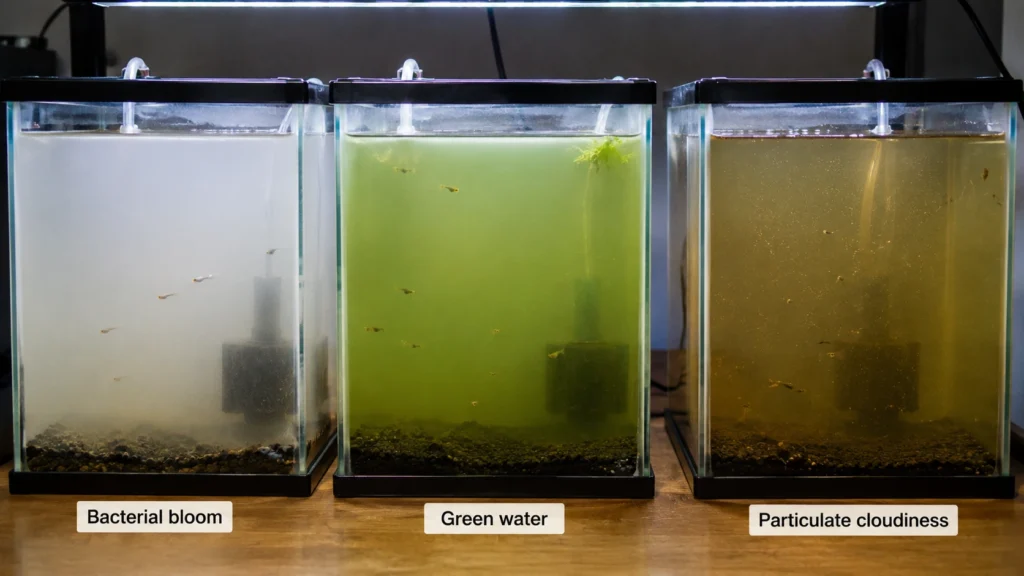
Here’s something I don’t see mentioned much: smell matters more than people realize. A bacterial bloom tank, in my experience, carries almost no odor difference. But if cloudiness comes with a faint sour or ammonia-like smell when you get close to the surface, that’s not a bloom anymore — that’s decomposition, and it changes everything about how urgently you need to act. I can’t say this is a scientifically validated diagnostic tool, it’s just something I’ve noticed consistently enough across my own tanks that I trust it now.
That morning, no smell, zero ammonia, uniform white haze — bacterial bloom, plain and simple.
The Real Causes Behind Cloudy Water in a Breeding Tank Specifically
Once I understood which type I was dealing with, the cause became almost obvious in hindsight. Breeding tanks create their own perfect storm for bacterial blooms, and it’s worth walking through why, because the reasons are different from what happens in a regular community tank.
Fry get fed more often than adult fish — I was feeding mine three to four small meals a day at that point, mostly to keep growth rates steady, and every bit of uneaten food or waste adds organic material to the water for bacteria to feed on. A sudden spike in that food source is basically an invitation for bacteria to multiply explosively, which is exactly what a bloom is. Then there’s the tank cycling itself. My 10-gallon had only been set up about three weeks earlier, which meant the beneficial bacteria colonizing the sponge filter hadn’t caught up to the bioload yet. A water change, even a modest one, can disturb that fragile early-stage colony just enough to trigger a visible bloom as the bacterial population resets and surges.
Low water volume makes all of this worse. It’s something people underestimate — a 10-gallon breeding tank reacts far faster and more dramatically to any imbalance than the 20-gallon display tank I keep my adult Guppies in, simply because there’s less water to dilute whatever’s happening. I’ve watched the exact same feeding mistake produce a mild haze in my display tank and a full-blown milky bloom in a 10-gallon fry tank within the same week. Less water means less buffer, plain and simple.
Add in gravel or substrate disturbance from cleaning, and you’ve got particulate cloudiness stacking on top of a bacterial one, which is genuinely confusing to diagnose if you don’t know to separate the two.
Why “Just Add a Sponge Filter” Isn’t the Full Answer
This is the part where I have to disagree with something I see repeated constantly, and it genuinely bothers me a little every time I read it. Ask about cloudy water in any breeding forum and someone will inevitably reply “get a sponge filter, problem solved.” I had a sponge filter running in that 10-gallon. It didn’t stop a thing.
The advice isn’t wrong exactly, it’s just incomplete, and incomplete advice is almost worse than no advice because it gives beginners false confidence. A sponge filter provides surface area for beneficial bacteria to colonize, sure, but that colonization takes time — weeks, not days — and a brand new sponge filter in a three-week-old tank is nowhere near mature enough to prevent a bloom triggered by a feeding increase or a water change. I’ve had sponge filters running for two months that still couldn’t keep up with an aggressive feeding schedule during a growth spurt.
What the advice conveniently leaves out is bioload management and feeding discipline, which matter just as much, arguably more, than the filtration hardware itself. You can have the best sponge filter money can buy and still get a bloom if you’re feeding four times a day into a tank that hasn’t finished cycling. I get a bit frustrated seeing this get passed around as a complete fix, because it sets beginners up to blame their equipment when the real issue is usually a combination of tank maturity and feeding habits. Equipment helps. It doesn’t replace time.
How I Actually Fixed It: Step-by-Step (What Worked in My Tank)
Once I’d figured out what I was actually looking at, fixing it stopped being complicated. It just took patience, which was the part I was worst at that week.
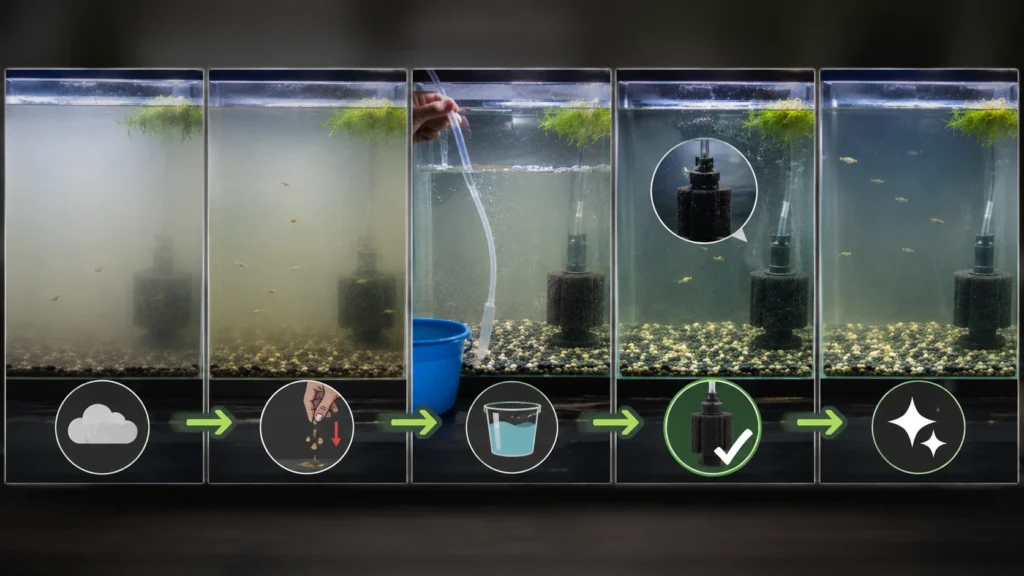
The first thing I did was cut feeding back to twice a day instead of four times, and I reduced the portion size on top of that. Less food going in meant less organic material feeding the bacterial spike, and this alone made a noticeable difference within about a day. Second, I did a small partial water change — around 20%, definitely not a full change, which is the instinct a lot of beginners have when they panic. I made that mistake once on an earlier tank, doing a near-complete water change out of fear, and it actually prolonged the bloom because it disturbed the bacteria that were trying to stabilize in the first place. A modest partial change dilutes the bloom without resetting everything the tank had built up.
Third, I left the sponge filter completely alone. No rinsing, no swapping it out, nothing. That filter was mid-cycle and needed to keep colonizing undisturbed, and touching it at that point would have set the whole process back further. Fourth — and this is the step I skipped the first time this happened to me on a different tank, and paid for with an extra week of cloudy water — I avoided gravel vacuuming entirely during the active bloom. Even a bare-bottom tank has some debris settling, and stirring it up mid-bloom just adds more particulate matter into an already unstable situation.
After that, it was mostly waiting. By day three the haze had visibly thinned. By day four, I could see all eighteen fry clearly again, swimming around like nothing had happened. No dead fry, no losses, just a genuinely stressful four days that taught me more than any care sheet had up to that point.
What Didn’t Work
Not everything I tried on other occasions was as useful, and I think it’s worth being honest about that instead of pretending I nailed this on the first attempt every single time.
A while after that Guppy incident, I dealt with a similar bloom in a Betta fry tank and decided to try a UV sterilizer, since a few breeders in an online group swore it cleared their cloudy water within a day. In my setup, it didn’t do much. The tank was small enough, and the flow rate through the UV unit low enough, that it barely seemed to touch the bloom — it cleared on roughly the same timeline it would have without any intervention at all. I’m not fully convinced it was a waste of money for larger setups with better flow rates, but for a small breeding tank under 15 gallons, I didn’t see the dramatic results people described.
I also tried one of those commercial “water clarifier” drops once, out of impatience more than anything. It made the water look marginally clearer within a few hours, but the bloom itself hadn’t actually resolved — the bacteria were still there, just clumped differently so they scattered less light. Within a day the haze crept back. It felt like treating the symptom rather than the actual cause, and I haven’t reached for it since. I know results vary by product and by tank, so I won’t say it’s useless across the board, just that it didn’t hold up in my own experience.
When Cloudy Water Is a Warning Sign, Not Just Cosmetic
Most of what I’ve described so far is the harmless version — mildly annoying, self-resolving, gone within a few days if you leave it alone and manage feeding. But not every cloudy tank is that simple, and I think this distinction gets glossed over too often.
The clearest red flag is an ammonia or nitrite reading above zero. I test with a liquid API kit rather than strips, mostly because I’ve found strips inconsistent when I’m trying to catch small early spikes, though that’s just a preference built from years of using both. If cloudiness shows up alongside any ammonia reading at all, that’s not a bloom running its course, that’s a cycle problem or a bioload problem that needs immediate action — a bigger water change than usual, a temporary reduction in feeding to almost nothing, and daily monitoring until the numbers come back down.
The other warning sign is a dead fry decomposing somewhere in the tank, which happens more than beginners expect, especially in tanks with plants or decor where a fry can get lost from view. This produces cloudiness that often comes with that faint sour smell I mentioned earlier, and it won’t resolve on its own the way a feeding-related bloom does — you have to physically find and remove the source. I’ve had to do a full visual sweep of a planted breeding tank more than once, moving java moss aside strand by strand, looking for exactly this.
As a rough guide from my own tanks, harmless bacterial bloom clears in two to four days with reduced feeding and patience. If it’s still there after five or six days, or ammonia shows up at any point, something else is going on and it’s worth investigating rather than waiting it out.
Pro Notes From Someone Who’s Cycled More Tanks Than They’d Like to Admit
A few things I’ve picked up that don’t always make it into the standard advice. I keep feeding at a fixed twice-a-day schedule for the first month of any new fry tank now, regardless of how hungry they look, because “just a little extra” is exactly how that Guppy bloom started. I also stagger my water changes across different tanks rather than doing them all on the same day, partly for my own sanity and partly because it means if a bloom does start, I’m not troubleshooting three tanks at once.
I still overfeed sometimes. I’d like to say seven years fixed that instinct completely, but it hasn’t — I catch myself dropping in a bit extra when fry look thin, and I’ve triggered a mild haze doing exactly that as recently as a few months ago. Old habits don’t fully go away, they just get caught faster.
One more thing: I’ve stopped trusting how a tank looks in the first 30 seconds after lights turn on. Cloudiness can look worse under direct light than it actually is, and I’ve nearly done unnecessary water changes based on a first glance before letting my eyes adjust and looking again a minute later.
Closing Thoughts
Cloudy water in a breeding tank feels a lot scarier than it usually is, especially the first time it happens to you. Most of the time it’s your tank telling you it’s still catching up, not that something’s gone badly wrong. Cut the feeding back, leave the filter alone, be patient, and actually test before you panic-change the water.
If you’re dealing with a cloudy tank right now, I’d genuinely like to hear what it looks like — the color, how fast it came on, whether there’s any smell to it. Drop it in the comments and I’ll do my best to help you figure out which type you’re actually looking at.

KD Sivanath is an aquarium enthusiast with over 7 years of experience in fish keeping and breeding. He specializes in helping beginners learn simple and effective methods for breeding popular aquarium fish. Through this blog, he shares practical tips, real-life experience, and easy-to-follow guides to help anyone start and succeed in fish breeding.