
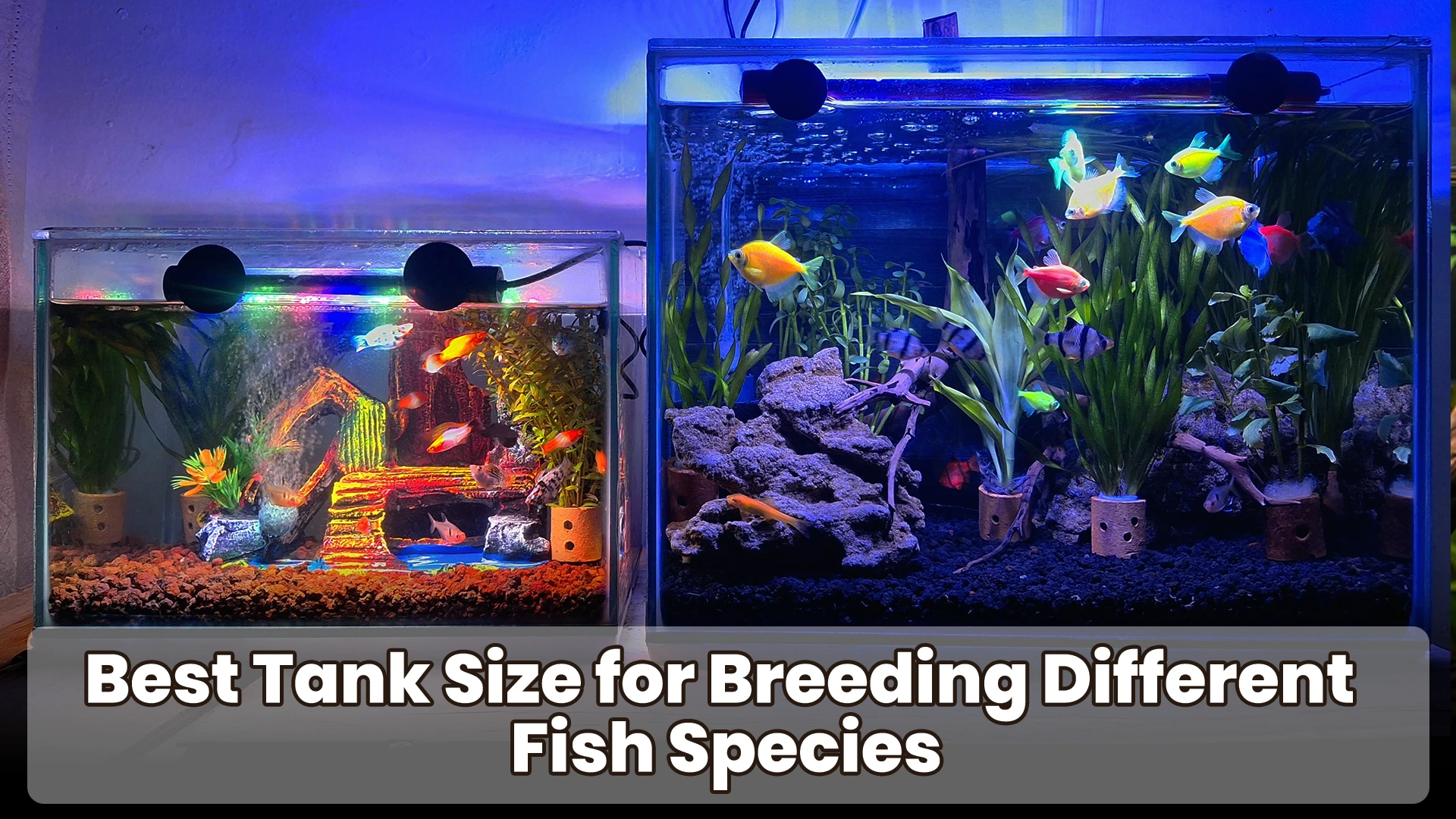
The first time I tried breeding fish, I made the classic rookie mistake — I figured “bigger is always better” and dumped my breeding pair into my biggest tank. Six months later, still no fry. Turns out, tank size isn’t about big or small. It’s about right.
I know how frustrating it is when you’ve done everything the care sheets told you to do — right temperature, right diet, right tank mates — and your fish still won’t breed, or worse, they breed and you lose every single fry within days. I’ve been doing this for over seven years now, and honestly, I still remember exactly how defeated I felt staring at that empty tank, wondering what I did wrong.
Nine times out of ten, when someone messages me asking what went wrong with their breeding attempt, the answer traces back to one overlooked thing: tank size. Not just “how big” — but the right kind of space for the specific fish you’re trying to breed. So let’s get into it properly, species by species, with real numbers and no guesswork.
Why Tank Size Actually Matters for Breeding (Not Just Fish Comfort)
Here’s the thing — most beginners think tank size is just about comfort. Give the fish room to swim, and you’re good, right? Not even close.
Breeding success depends on fish breeding tank size matching the natural behavior of the species you’re working with, not just meeting a minimum “don’t suffocate” number.
It’s About Territory, Not Just Swimming Room
Breeding behavior is territorial behavior. A male betta building a bubble nest needs to feel like he owns his patch of water. A cichlid guarding a spawning site will fight for it. When the tank is too small, there’s nowhere for a stressed or losing fish to retreat — and that’s when things turn violent, or breeding just doesn’t happen at all.
How Tank Size Affects Water Stability During Breeding
This one surprised me early on. Smaller tanks swing in temperature and ammonia levels far faster than larger ones. During breeding, water stability isn’t a nice-to-have — it’s the difference between eggs hatching cleanly and eggs going fuzzy with fungus overnight.
I’ve watched a 5-gallon tank spike from 0.25 ppm to over 1 ppm ammonia in about 48 hours once fry started producing waste. That’s a death sentence for a fry batch if you’re not on top of water changes.
Important: Ammonia at even 0.5 ppm can stress or kill fry, even though adult fish might tolerate it briefly. Test your water daily during the first two weeks after hatching — this single habit has saved more of my fry batches than anything else.
The Overcrowding vs. Isolation Trap
And on the flip side — too much space isn’t automatically better either. Shy breeders like bettas can get so overwhelmed in a large, open tank that they never settle enough to spawn.
My Experience: I once moved a breeding pair into a 20-gallon tank thinking “more room, happier fish.” They just hid for three weeks straight and never spawned. I moved them back down to a 10-gallon with dense floating plants, and within four days, I had a bubble nest. Lesson learned — bigger isn’t always the goal, appropriate is.
So if size alone isn’t the magic number, what actually decides the right tank? Let’s break it down species by species, because this is where most guides get frustratingly vague — and where I want to be as specific as possible.
Best Tank Size for Betta Fish Breeding
Bettas are probably the fish I get asked about the most, so let’s start here.
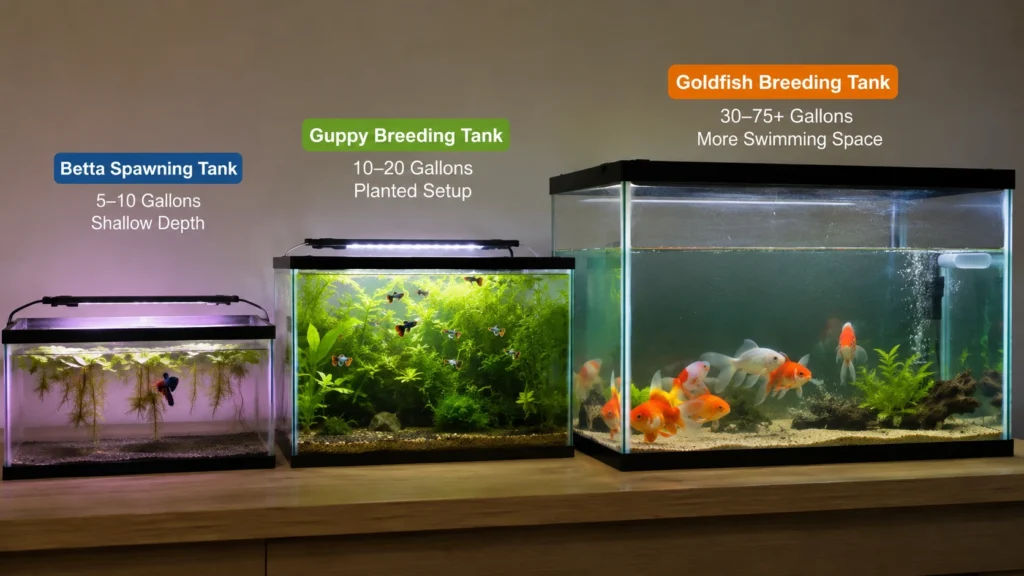
Minimum tank size: 5 gallons Ideal tank size: 10 gallons Water depth: 6–8 inches (shallower than you’d think)
Breeding Behavior
Male bettas build bubble nests at the water’s surface, usually among floating plants like water sprite or Amazon frogbit. Once spawning happens, the male collects the eggs in his mouth and places them in the nest, guarding them obsessively — including chasing the female away once she’s done her job.
Ideal Gallon Range for Betta Spawning Tanks
For betta breeding, I stick to a 5 to 10-gallon tank. Anything smaller and water quality becomes nearly impossible to manage once fry hatch — a single spawn can produce anywhere from 30 to 500 eggs, depending on the pair’s age and condition. Anything much bigger, and the male can lose confidence guarding his nest across too much open water.
Why Bettas Need Shallower Water, Not Just Smaller Tanks
Here’s something a lot of care guides skip entirely — water depth matters as much as volume. I keep breeding tanks around 6 to 8 inches deep. Betta fry are weak swimmers for the first few days after hatching, and if they sink too far from the bubble nest, they can’t make it back up in time. Shallow water means less distance to fall, and fewer fry lost in the first 48 hours.
Setting Up the Breeding vs. Grow-Out Tank Separately
What I’ve found is that trying to breed and raise fry in the same tank almost never works long-term. I move fry to a separate grow-out tank around week two, once they’re free-swimming and eating baby brine shrimp on their own. Keeping breeding and grow-out tanks separate also means I can pull the male out immediately if he starts getting aggressive toward the fry — which does happen once the fry become mobile and start swimming out of the nest area.
Common Mistakes with Betta Breeding Tanks
- Using a tank that’s too tall, forcing fry to swim further to reach the surface for air
- Adding a filter with too much flow, which exhausts fry and disrupts the bubble nest
- Leaving the female in with the male too long after spawning (he will attack her)
Practical Tips & Fry Survival
Pro Tip: Use a sponge filter instead of a hang-on-back filter in betta breeding tanks. The gentle flow won’t suck up fry or destroy the bubble nest, and it still keeps ammonia in check.
Fry survival in the first week largely depends on temperature stability (keep it steady at 78–80°F / 25.5–26.5°C) and having infusoria or liquid fry food ready before the fry become free-swimming, since they’re too small for baby brine shrimp initially.
Bettas are loners by nature — but what about fish that breed in groups, like guppies?
Best Tank Size for Guppy Breeding
A lot of people ask me, “can I breed guppies in a 5-gallon?” and honestly? Technically yes, but I wouldn’t recommend it for anything beyond a one-off accidental litter.
Minimum tank size: 10 gallons Ideal tank size: 20 gallons Water depth: Not a major factor — standard tank proportions work fine
Breeding Behavior
Guppies are livebearers, meaning females give birth to free-swimming fry rather than laying eggs. A single female can store sperm and produce multiple broods from one mating, which is part of why populations grow so fast.
Minimum Tank Size for a Healthy Guppy Colony
My honest take is 10 gallons minimum for a small guppy breeding colony (say, 2–3 females to 1 male), and closer to 20 gallons if you want a sustainable, ongoing setup without constant rehoming stress. Guppies breed fast — a female can drop 20 to 60 fry every 4 weeks — and that math adds up quicker than beginners expect. I’ve had a single 20-gallon tank go from 6 adults to over 80 fish in under four months.
Why Guppies Need Extra Space to Prevent Fry Predation
Here’s the part nobody tells new breeders: guppies will eat their own fry. It’s not cruelty, it’s just instinct — fry look like food to an adult guppy. More space, more plants, more hiding spots — that’s what actually gives fry a fighting chance at survival, not the parents suddenly developing manners.
Using Breeder Boxes vs. Full Tank Setups
Personally, I’m not a huge fan of breeder boxes as a long-term solution — I’ve used them, and while they’re great for isolating a pregnant female right before she drops fry (you’ll notice a dark “gravid spot” near her belly a few days before), keeping fry cramped in a floating box for weeks stunts their growth. I use mine for maybe 48–72 hours max, then move fry into a proper grow-out space with dense plants like guppy grass or hornwort.
Common Mistakes with Guppy Breeding Tanks
- Keeping too many males, which stresses females through constant chasing
- Not separating fry fast enough, leading to them becoming a snack
- Overcrowding the main tank until water quality collapses under bioload
Practical Tips & Fry Survival
Pro Tip: Floating plants aren’t optional here — they’re doing double duty as fry hiding spots and biological filtration. I never run a guppy breeding tank without a thick mat of them at the surface.
Now let’s scale things up — literally — for one of the most popular beginner fish: goldfish.
Best Tank Size for Goldfish Breeding
This is where I see the most beginners get blindsided, because goldfish get sold as “easy, low-maintenance fish.”
Minimum tank size: 40 gallons Ideal tank size: 55–75 gallons (or an outdoor pond) Water depth: Standard, but horizontal swimming space matters more than height
Breeding Behavior
Goldfish are egg scatterers — males chase females vigorously around the tank (this is called “the chase”) and fertilize eggs as they’re released, usually scattered across plants or spawning mops rather than guarded like betta eggs.
Why Goldfish Need Significantly More Space Than People Expect
In my experience, that “low-maintenance” reputation is honestly kind of a myth once you’re trying to breed them. Goldfish are messy, they grow large, and their bioload during spawning season is intense. I recommend a minimum of 40 gallons for a breeding pair, and closer to 55–75 gallons if you’re working with fancy varieties that produce large spawns.
Ideal Gallon-Per-Fish Ratio for Breeding Pairs
The rule of thumb I follow is roughly 20 gallons per adult goldfish, minimum, before even factoring in fry. And that number matters more than people think — goldfish typically lay anywhere from 500 to 1,000 eggs in a single spawn, and yes, that number shocked me the first time I saw it happen in my own tank. Not all of them will be fertilized or survive, but even a 10% hatch rate is a lot of fry to plan space for.
Pond vs. Tank Breeding Considerations
If you’ve got the option, I’ll be straight with you — outdoor ponds almost always outperform indoor tanks for goldfish breeding. The extra volume, natural temperature fluctuation, and algae growth all support fry survival rates far better than a glass box ever will. But I get that not everyone has pond access, so indoors, just budget for way more tank than you think you need.
Common Mistakes with Goldfish Breeding Tanks
- Underestimating adult size — fancy goldfish can reach 6–8 inches, common goldfish much larger
- Not providing spawning mops or fine-leafed plants for egg scatter sites
- Leaving fry in with adults, who will happily eat their own eggs and fry
Practical Tips & Fry Survival
Common Mistake: Assuming goldfish don’t need a heater because they’re “cold water fish.” Breeding still benefits from a gentle, gradual temperature rise into the 65–72°F (18–22°C) range to trigger spawning — sudden cold snaps can halt the process entirely.
If goldfish need room to roam, cichlids need room to negotiate — these fish come with their own breeding drama.
Best Tank Size for Dwarf Cichlid Breeding
Dwarf cichlids (rams, apistogramma, and similar species) are a fantastic entry point into cichlid breeding without needing a massive setup.
Minimum tank size: 20 gallons Ideal tank size: 29 gallons Water depth: Standard; floor footprint matters more than height
Breeding Behavior
Dwarf cichlids are substrate spawners — they’ll clean a flat rock, piece of slate, or even a leaf, lay eggs on it, and both parents typically guard the site fiercely, taking turns fanning the eggs with their fins to keep them oxygenated.
Species-Specific Sizing
For dwarf cichlids like German blue rams or apistogramma, 20 to 29 gallons works well for a single breeding pair. Going smaller tends to concentrate aggression and waste too much for comfort, especially since these species are sensitive to water quality swings.
Common Mistakes with Dwarf Cichlid Tanks
- Pairing fish too young before they’re sexually mature and properly bonded
- Poor water parameters — dwarf cichlids are notably sensitive to pH swings
- Not providing a flat spawning surface, which can delay or prevent spawning entirely
Practical Tips & Fry Survival
My Experience: With rams especially, I’ve found soft, slightly acidic water (pH 6.0–6.5) makes a noticeable difference in spawning success compared to harder, more alkaline water. It’s a small adjustment that made a real difference for me.
Best Tank Size for African Cichlid Breeding
Cichlids are honestly where I learned the hard way that tank size and aggression are directly linked.
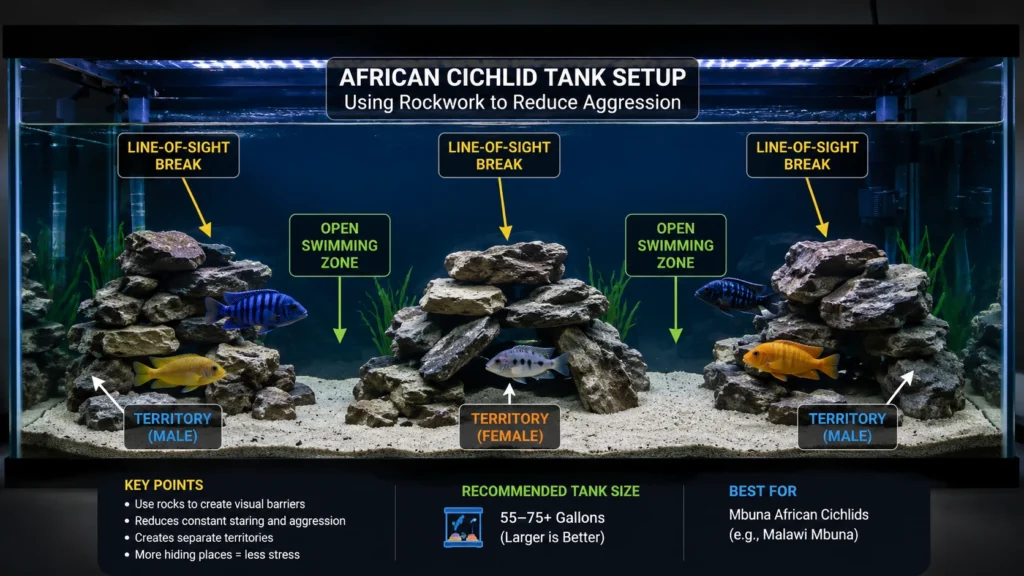
Minimum tank size: 55 gallons Ideal tank size: 75+ gallons Water depth: Standard; wide floor footprint with rock structure is essential
Breeding Behavior
Most popular African cichlids (like Mbuna and many peacock species) are mouthbrooders — after spawning, the female collects fertilized eggs into her mouth and carries them for 21 to 30 days until they’re ready to be released as free-swimming fry.
Territory and Aggression: Why Bigger Tanks Prevent Bloodshed
I’ll never forget the time I put two cichlids in a 30-gallon tank that was really meant for one breeding pair with buffer room. Within a week, one had torn fins and was hiding behind the filter, refusing to eat. That was on me — not enough territory meant constant conflict instead of courtship.
Important: More space, combined with plenty of rock structures to break sightlines between fish, makes an enormous difference in reducing aggression. Rockwork isn’t decoration here — it’s functional territory division.
Mouthbrooders vs. Substrate Spawners — Different Space Needs
This one’s easy to overlook. Mouthbrooding cichlids don’t need dedicated spawning territory the way substrate spawners do, since the female carries the eggs herself — but the group still needs enough space to establish a stable pecking order without constant harassment. Substrate spawners, on the other hand, need a defensible flat surface or cave, plus buffer space around it.
Common Mistakes with African Cichlid Tanks
- Not maintaining a proper male-to-female ratio (too many males spikes aggression sharply)
- Skipping rockwork, leaving nowhere for weaker fish to retreat
- Removing a holding female too abruptly, which can cause her to spit eggs prematurely from stress
Practical Tips & Fry Survival
I usually keep a ratio of 1 male to 3–4 females minimum for Mbuna species to spread out aggression. Once a female is holding eggs, I try to minimize disturbance to the tank — sudden movements or net chasing can cause her to release the eggs too early.
By now you’ve probably noticed a pattern — so let’s put it all together in one simple reference.
Quick-Reference Tank Size Chart by Species
I made this chart mostly for my own sanity after answering the same “how big should my tank be” question more times than I can count — hope it saves you some scrolling.
| Species | Minimum Tank Size | Ideal Tank Size | Adult Size | Spawn Size | Water Temp | pH | Difficulty | Special Notes |
|---|---|---|---|---|---|---|---|---|
| Betta | 5 gallons | 10 gallons | 2.5–3 in | 30–500 eggs | 78–80°F (25.5–26.5°C) | 6.5–7.5 | Beginner | Shallow water (6–8 in) critical |
| Guppy | 10 gallons | 20 gallons | 1.5–2.4 in | 20–60 fry/batch | 74–78°F (23–25.5°C) | 7.0–7.5 | Beginner | Livebearer, breeds constantly |
| Goldfish | 40 gallons | 55–75 gallons | 6–8+ in | 500–1,000 eggs | 65–72°F (18–22°C) | 7.0–8.4 | Intermediate | Pond breeding often outperforms tanks |
| Dwarf Cichlid | 20 gallons | 29 gallons | 2–3 in | 30–80 eggs | 78–82°F (25.5–28°C) | 6.0–6.5 | Intermediate | Sensitive to water quality |
| African Cichlid | 55 gallons | 75+ gallons | 4–6+ in | 20–60 fry (mouthbrooders) | 76–82°F (24.5–28°C) | 7.8–8.6 | Intermediate–Advanced | Needs strong rockwork territory |
General Rule of Thumb: Gallons Per Fry Batch
If I had to boil it down to one rule, it’s this: plan for roughly 1 gallon per 1–2 inches of adult fish, then add extra buffer volume for fry waste. It’s not perfect science, but it’s kept me out of trouble for years.
When to Upgrade Tank Size as Fry Grow
Don’t set it and forget it. I upgrade grow-out tanks roughly every 4–6 weeks as fry size up, especially with fast growers like goldfish and cichlids. What worked at week one is usually way too crowded by week six.
Numbers are great, but size is only half the equation — here’s what most beginners overlook.
Common Tank Size Mistakes That Ruin Breeding Attempts
Going Too Small “To Save Money”
Look — I get it, tanks aren’t cheap. But going undersized to save a few dollars almost always costs more later, whether that’s in dead fry, medication for sick fish, or buying a bigger tank anyway three months in. Ask me how I know.
Ignoring Water Volume vs. Footprint Differences
This one trips people up constantly. A tall, narrow 20-gallon tank does not behave the same as a long, low 20-gallon “long” tank — even though the gallon number is identical. For bottom-spawning fish especially, footprint matters more than height.
Not Planning for Fry Grow-Out Space
Honestly? This is the mistake I see most. People plan the breeding tank perfectly and then have absolutely nowhere to put 200 fry two weeks later. Plan your grow-out space before you start breeding, not after.
Copying Someone Else’s Setup Without Adjusting for Species Differences
I see this a lot in Facebook groups — someone shares a tank size that worked great for their guppies, and a beginner tries the exact same setup for cichlids. Different species, different bioload, different behavior. What works for one almost never transfers directly.
Underestimating Bioload as Fry Grow
A tank that comfortably held 10 tiny fry at two weeks old can be dangerously overstocked by 50 fry at eight weeks. Bioload isn’t static — it grows with the fish, and your aquarium breeding tank setup needs to scale with it.
Skipping a Cycled Tank Before Breeding
This one’s sneaky. Some breeders set up a brand-new tank specifically for breeding and skip the nitrogen cycle entirely, assuming water changes alone will handle it. An uncycled tank plus a fresh fry bioload is a recipe for an ammonia spike within days.
At the end of the day, breeding success isn’t about guesswork — it’s about giving your fish the space they’re wired to thrive in.
Frequently Asked Questions
Q: What’s the smallest tank I can breed fish in? It depends entirely on species. Bettas can work in a 5-gallon spawning setup, but most other species — guppies, goldfish, cichlids — need considerably more room to prevent stress and water quality crashes.
Q: Do I need a separate breeding tank and grow-out tank? For most species, yes. I’ve found that trying to breed and grow fry in the same space almost always ends in lost fry, either from predation or from water quality issues once fry start adding to the bioload.
Q: Can I breed fish in a community tank? Generally, I’d avoid it. Fry survival rates drop dramatically in a community setup since other fish (and sometimes even the parents) will eat them. A dedicated breeding tank setup gives you far better odds.
Q: How do I know if my tank is too small? Watch for signs like constant aggression, fish hiding and refusing to eat, or ammonia spikes you can’t get under control even with regular water changes — those are all red flags that space is the problem.
Q: Does tank shape matter as much as gallon size? Yes, more than people expect. A tall betta tank isn’t ideal even at the right gallon count, while cichlids need floor space for territory more than they need height.
Q: How long should I wait before moving fry to a grow-out tank? This varies by species, but as a general guide, I move fry once they’re free-swimming and eating on their own — usually around 1–2 weeks for bettas and guppies, and a bit longer for mouthbrooding cichlids once the female releases them.
Q: Do I need a heater for every breeding tank? Most tropical species (bettas, guppies, cichlids) do, since stable warm temperatures trigger and support breeding. Goldfish are the exception — they breed in cooler water and generally don’t need a heater.
Q: What’s the biggest sign a tank is the right size for breeding? Honestly, it’s behavior. When a pair settles in, starts displaying normal courtship behavior (nest building, chasing, digging), and isn’t showing constant stress signs, that’s usually a good sign the space is working for them.
Q: Can I use a divided tank to breed multiple species at once? I wouldn’t recommend it for serious breeding attempts. Dividers can help with temporary isolation, but vibrations and visual stress from neighboring tank sections can disrupt spawning behavior, especially in sensitive species like dwarf cichlids.
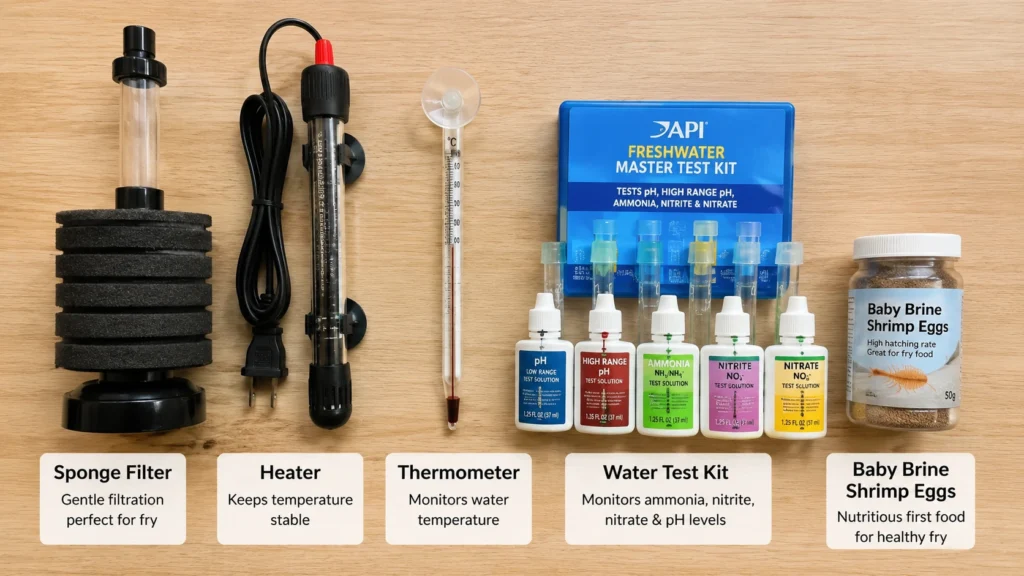
Q: How much does an ideal breeding tank setup typically cost to get started? It varies a lot by species and tank size, but for a basic betta or guppy breeding setup, budget for the tank itself, a sponge filter, a reliable heater, and a thermometer. Larger setups like goldfish or African cichlid tanks obviously cost more due to size and filtration needs.
Key Takeaways
- Tank size for breeding isn’t just about “bigger is better” — it’s about matching size, shape, and depth to the species’ natural behavior.
- Bettas need shallow, moderate-sized tanks (5–10 gallons); guppies need slightly more room (10–20 gallons) due to fast breeding cycles.
- Goldfish and African cichlids need significantly more space than people expect — 40+ and 55+ gallons respectively.
- Water stability, not just tank size, determines whether eggs and fry actually survive.
- Always plan grow-out space before breeding, since fry populations grow faster than most beginners anticipate.
- Territory and aggression management (especially for cichlids) depends heavily on adequate space and rockwork.
Breeding Tank Checklist
Before you start a new breeding attempt, run through this:
- Tank size matches the species’ minimum-to-ideal range
- Water depth is appropriate for the species (especially for bettas)
- Tank is fully cycled before introducing a breeding pair
- Heater and thermometer are installed and calibrated
- Filtration is gentle enough not to harm eggs or fry (sponge filter recommended)
- Hiding spots, plants, or spawning surfaces are in place
- Separate grow-out tank is ready before fry arrive
- Water testing kit on hand for daily ammonia/nitrite checks
- Fry food (infusoria, baby brine shrimp, or crushed flake) sourced in advance
- Plan in place for removing aggressive parents if needed
Further Reading
For readers who want to go deeper into water chemistry, species-specific care, and breeding science, these are reputable resources worth exploring:
- American Cichlid Association — species profiles and breeding resources for cichlid keepers
- International Betta Congress — betta-specific breeding standards and community resources
- Fishbase — a scientific database of fish species, including breeding and habitat data

KD Sivanath is an aquarium enthusiast with over 7 years of experience in fish keeping and breeding. He specializes in helping beginners learn simple and effective methods for breeding popular aquarium fish. Through this blog, he shares practical tips, real-life experience, and easy-to-follow guides to help anyone start and succeed in fish breeding.