
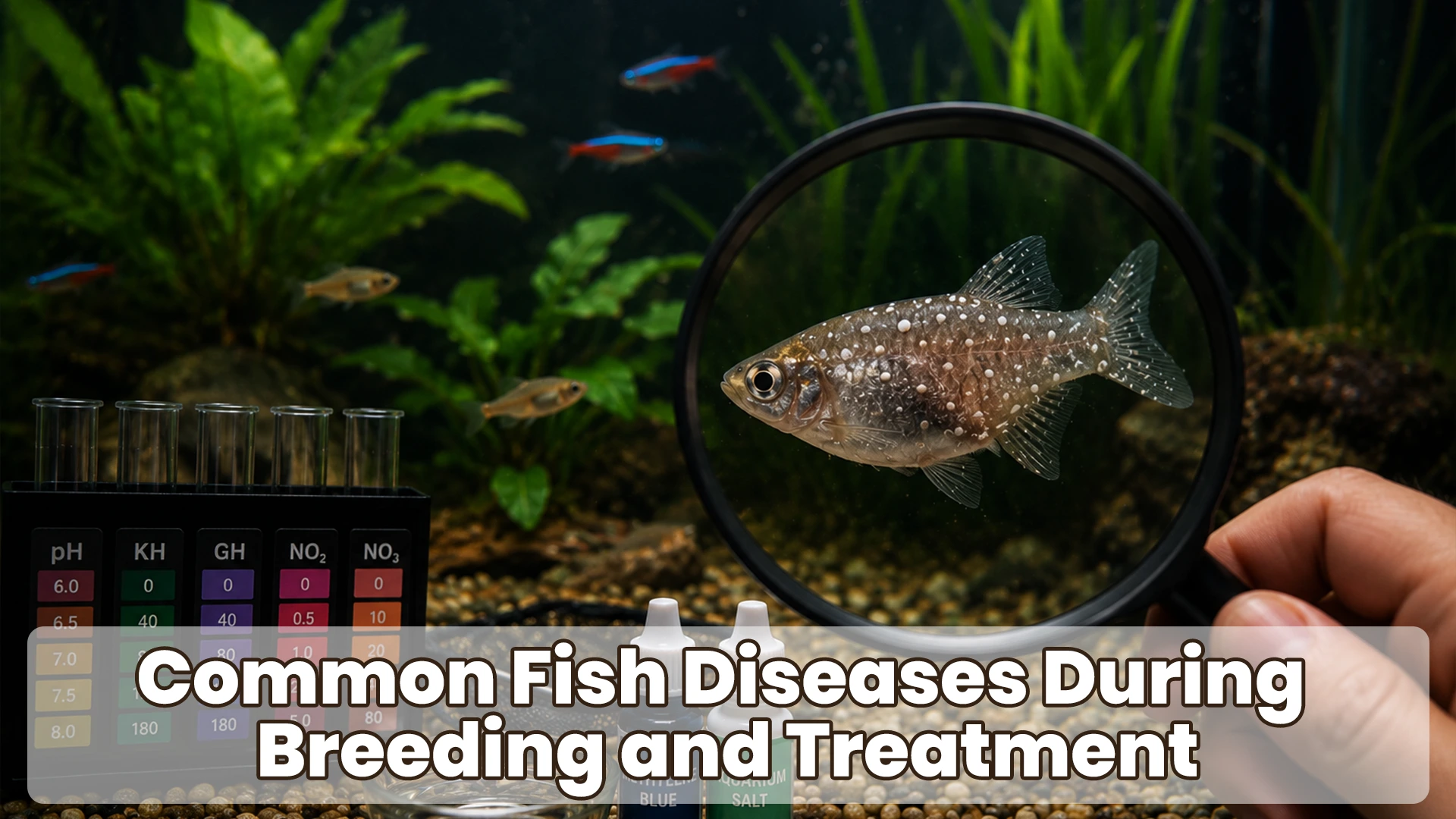
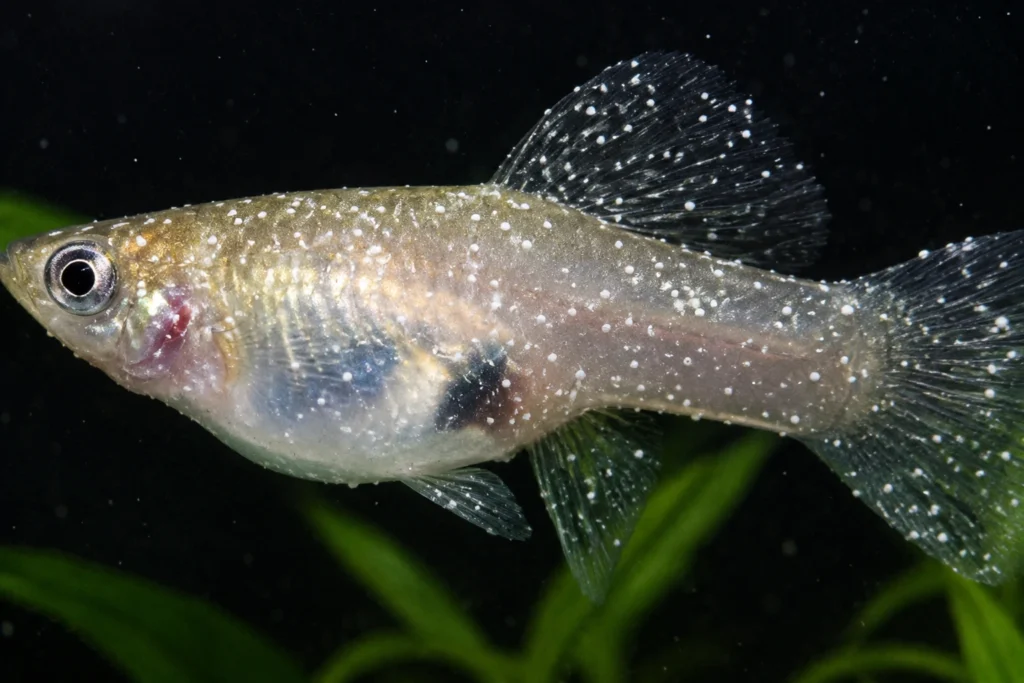
I still remember the morning that changed how I think about breeding tank health for good. It was early monsoon season, the kind of week where the temperature drops without warning overnight, and I walked into my fish room to find a batch of guppy fry covered in what looked like tiny grains of salt. By the time I figured out what was happening, I’d already lost close to half the batch.
That was my first real encounter with ich in a breeding tank, and it taught me something I now tell every beginner breeder: breeding tanks get sick faster, and hit harder, than almost any other tank in your fish room.
If you’ve ever spent weeks conditioning a breeding pair, finally gotten eggs or fry, and then watched it fall apart in a couple of days — you’re not alone, and you’re probably not doing anything unusually wrong. Breeding tanks behave differently from community tanks. The extra feeding, the fry bioload, the stress of spawning itself — it all adds up to a setup that’s genuinely more vulnerable to disease.
This guide covers the diseases that actually show up during breeding — fungal, bacterial, and parasitic — why breeding tanks are so susceptible to them, and how to treat outbreaks without wrecking your cycle or harming fragile fry in the process. It’s built from years of hands-on breeding experience, including the mistakes that taught me the most.
A quick note before we start: I’m not a veterinarian, and this article isn’t a substitute for professional aquatic veterinary advice, especially for valuable or aquaculture-scale stock. Always follow manufacturer instructions on any medication, and when in doubt, consult resources like university aquaculture extension programs or your local fisheries department.
Why Breeding Tanks Are More Vulnerable to Disease
A breeding tank looks the same as any other aquarium from the outside. Underneath, though, it’s running under a completely different kind of pressure — and that pressure is exactly why disease takes hold so much faster here.
Stress Weakens Immunity Before You Notice Anything
Breeding fish deal with constant physical demands: chasing, flaring, guarding eggs, defending territory. That stress suppresses a fish’s immune response, sometimes within a matter of hours. Many of the pathogens responsible for breeding tank diseases are already present at low, harmless levels in most established aquariums — they only become a real problem once a fish’s natural defenses drop.
Feeding and Waste Load Change Everything
You feed more during breeding — both to condition adults and to keep fry growing — and more food means more waste. In a small breeding tank, that can push ammonia and nitrite levels up much faster than they would in a stable community tank, especially if fry are being fed multiple small meals a day, which most species genuinely need at that stage.
Fry Overcrowding Multiplies the Risk
A single goldfish spawn can produce anywhere from 500 to 1,000 eggs, and even with a modest survival rate, that’s still a lot of fry packed into a tank that was never designed to hold them. Overcrowding doesn’t cause disease on its own, but it accelerates almost everything else on this list — faster waste buildup, more physical contact between fish, and quicker pathogen spread.
Once you understand why breeding tanks are this vulnerable, the specific diseases that show up start to make a lot more sense.
Fungal Infections in Fish During Breeding
Cotton-Wool Fungus on Eggs and Fry
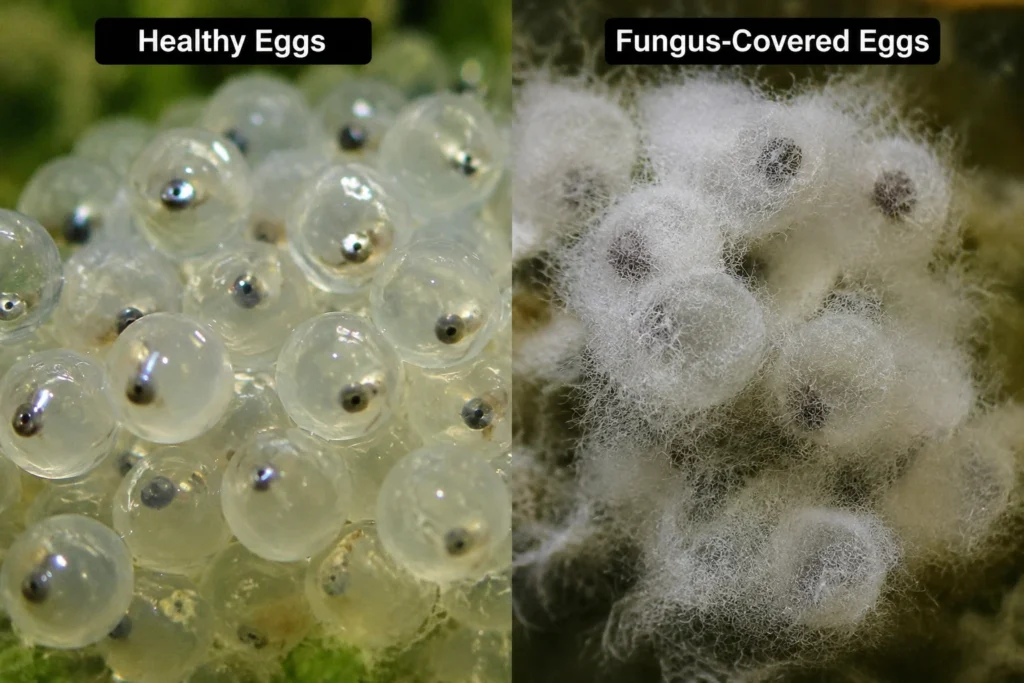
This is usually the first thing new breeders panic about — white, fuzzy, cotton-like growths appearing on eggs almost overnight. It typically starts on unfertilized or dead eggs and spreads to healthy ones nearby if it isn’t caught early.
Saprolegnia in Stressed Adult Fish
Saprolegnia is the fungal genus most commonly responsible for that cotton-wool appearance, and it doesn’t limit itself to eggs. It readily takes hold on injured or heavily stressed adult fish — a torn fin after a rough spawning session is an easy entry point.
Preventing Fungal Growth During Egg Incubation
One of my zebra danio spawns went visibly fuzzy within a single night. What helped afterward, and what I now do with every egg batch, is removing unfertilized or dead eggs daily with a turkey baster, since fungus spreads outward from dead tissue. Keeping incubation water stable — commonly recommended around 77–80°F for many egg-laying species, though this varies by fish — and adding gentle water movement across the eggs also reduces fungal risk significantly.
Pro tip: A small air stone positioned to create gentle current across an egg pile does more to prevent fungus than any medication added after the fact.
Fungus is frustrating, but bacteria can move even faster through a breeding tank — and it’s often harder to catch in the early stages.
Bacterial Infections in Fish During Breeding
Fin and Tail Rot After Spawning
Male bettas especially take a beating during spawning — flaring, nipping, and wrapping around the female repeatedly. Torn fins are an open door for bacteria, and fin rot can develop within a day or two if water quality isn’t kept in check.
Dropsy and Bloating in Post-Spawn Females
Dropsy shows up as a swollen belly and raised, pinecone-like scales, most often in females run down after heavy egg production. By the time the pinecone appearance is visible, the prognosis is usually poor — which is exactly why catching subtler bloating or lethargy early matters so much more than trying to treat advanced dropsy.
Columnaris: A Fast-Moving Bacterial Threat
Columnaris is one of the more serious bacterial infections in fish to watch for during breeding. It can progress quickly, sometimes within a couple of days, and typically shows up as white or grayish patches around the mouth and gills — occasionally nicknamed “cotton mouth” even though it’s bacterial, not fungal.
Real experience: I once had a breeding pair of bettas where the male’s fins were torn fairly badly during spawning. I treated it as minor and waited. Two days later, the injury had progressed into a serious bacterial infection, and I lost him. The lesson stuck with me: any torn fin on a breeding fish should be addressed within 24 hours, not left to “see how it goes.”
Bacteria tend to hit adult fish the hardest, but parasites are often the ones that quietly wipe out an entire fry batch before you even notice something’s wrong.
Parasitic Fish Diseases in Breeding Tanks
Ich (White Spot Disease) and Temperature Instability
Ich thrives on unstable water temperatures — its lifecycle actually speeds up in cooler water, which is exactly what happens during sudden overnight temperature drops. This ties back to that guppy fry outbreak I mentioned earlier. According to commonly referenced aquaculture guidance, raising tank temperature into the low-to-mid 80s°F (alongside appropriate medication) can help shorten the ich lifecycle and speed recovery — though exact protocols vary depending on the species being treated, so it’s worth checking species-specific tolerance first.
Velvet Disease in Newly Hatched Fry
Velvet gives fish a fine gold or rust-colored dusting on the skin, and it’s often easiest to spot under angled flashlight light rather than normal tank lighting. Fry have very little natural defense against it, so daily visual checks during the first couple of weeks are worth the effort.
Gill Flukes and Breathing Problems in Fry
Fry gasping at the surface or clamping their gills isn’t automatically an oxygen problem. Gill flukes cause nearly identical symptoms, which makes this an easy one to misdiagnose if you’re not looking closely or ruling out other causes first.
That original guppy outbreak traced back to an overnight temperature drop during a cold front — nothing dramatic, just a few degrees, but enough to trigger a fast-moving ich outbreak. What I wish I’d had at the time was a simple thermostat-controlled heater on that tank. I’d assumed ambient temperatures were “warm enough” year-round, which turned out not to hold true overnight, especially during monsoon season.
Fry-specific diseases deserve their own section, because what’s a safe, standard treatment for adult fish can be genuinely dangerous for fry.
Fish Fry Diseases: Why Fry Get Sick Faster
An Immature Immune System
Fry are essentially operating with an underdeveloped immune system for the first several weeks of life. Conditions an adult fish would shrug off can spread through a fry batch far more aggressively, which is part of why fish fry diseases are treated as their own category rather than a smaller version of adult disease.
Swim Bladder Issues and Deformities
Not every fry problem is infectious. Swim bladder issues and mild spinal curvature can result from water quality stress or genetic factors during early development, and while they look alarming, they aren’t contagious the way fungal or bacterial infections are.
Bacterial Gill Disease in Overcrowded Fry Tanks
Fry crowded into an under-filtered tank are particularly prone to bacterial gill disease — look for fry hanging near the surface, gasping, or growth that seems to be stalling compared to the rest of the batch.
Mistake I made early on: My first attempt at dosing methylene blue in a fry tank went badly. I used a dosage meant for standard adult tank volumes without scaling it down, and lost a significant portion of that batch — not to disease, but to the medication itself. Fry are far more sensitive to standard medication doses than adults, and most treatments need to be reduced substantially. Always check species- and age-specific dosing guidance, and when unsure, start lower than the label suggests.
Knowing which disease you’re dealing with is only half the job. Dosing medication safely around eggs and fry is where a lot of beginners run into trouble.
Safe Aquarium Fish Medication for Breeding Tanks
Medications Generally Considered Safer Around Eggs and Fry
| Disease Type | Often Considered Fry/Egg-Safer* | Typically Adult-Only |
|---|---|---|
| Fungal (Saprolegnia, cotton-wool) | Methylene blue, low dose | Malachite green |
| Bacterial (fin rot, columnaris) | Aquarium salt, low dose | Antibiotics (e.g., erythromycin) |
| Parasitic (ich, velvet) | Raised temperature + gentle salt | Copper-based treatments |
Always confirm with the product label and manufacturer instructions — sensitivity varies by species, and some fish (notably scaleless species and certain catfish) tolerate salt and copper-based treatments poorly.
Adjusting Dosage for Small Breeding Tanks
Most medication instructions are written with standard 10-gallon-plus tanks in mind. When treating a small 2.5–5 gallon fry tank, it’s generally safer to start well below the labeled dose and observe for at least 12 hours before adjusting, since fry tolerate very little margin for error.
When a Separate Hospital Tank Makes More Sense
If a disease is bacterial, or if it’s affecting an adult breeding pair rather than fry directly, moving the sick fish to a separate, already-cycled hospital tank is usually the safer route. It protects your main biological filter and avoids exposing healthy eggs or fry to medication they don’t need.
Pro tip: Keep a small hospital tank cycled and ready year-round, not just when you need it. Since I started doing this consistently, disease-related losses across my breeding projects have dropped noticeably — enough that I now consider it a non-negotiable part of any breeding setup.
Treatment matters when something goes wrong, but prevention is really what keeps a breeding project healthy over the long run.
Fish Disease Prevention: Building a Breeding Health Routine
Quarantine New Breeding Stock
New breeding stock should go through a quarantine period — commonly two weeks or more — before being introduced to an established breeding tank. A large share of the worst outbreaks I’ve dealt with over the years trace back to skipping this step.
A Water Change Schedule That Actually Prevents Problems
For active breeding and fry-rearing tanks, more frequent partial water changes — for example, smaller changes done twice a week rather than one larger weekly change — help offset the extra feeding load these tanks carry. This single habit prevents more disease than any medication I’ve ever used.
Recognizing Fish Disease Symptoms Early
Check for these daily during active breeding:
- Clamped fins or unusual resting position
- Loss of appetite or slower feeding response
- Unusual dark, pale, or blotchy coloring
- Gasping at the surface or rapid gill movement
- Visible spots, fuzz, or discoloration on skin or fins
Catching any of these within the first day is consistently the biggest factor in whether treatment actually works.
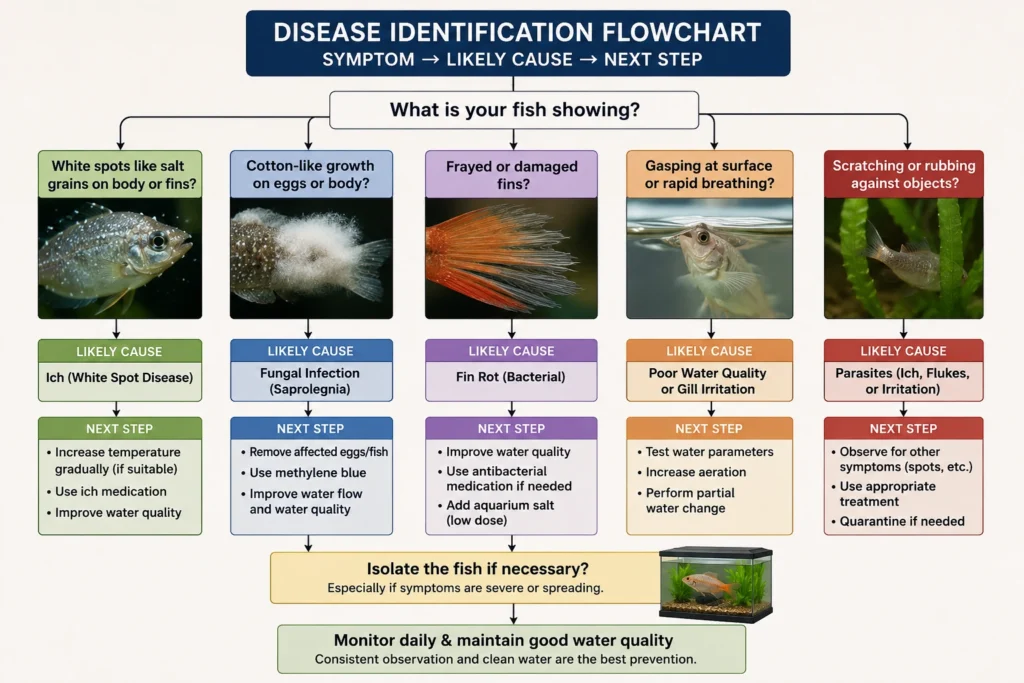
None of this needs to be complicated. It just needs to be consistent, especially during the weeks around active spawning.
Quick Reference: Common Symptoms by Disease Type
| Symptom | Likely Cause | First Response |
|---|---|---|
| White cotton-like growth | Fungal infection (Saprolegnia) | Remove affected eggs/tissue, adjust water flow |
| White or gray patches near mouth/gills | Columnaris (bacterial) | Isolate fish, consult species-safe antibacterial treatment |
| Small white spots across body | Ich (parasitic) | Gradual temperature increase, appropriate medication |
| Gold/rust dusting on skin | Velvet (parasitic) | Darken tank, use appropriate anti-parasitic treatment |
| Swollen belly, raised scales | Dropsy (often bacterial/systemic) | Isolate, improve water quality, consult experienced source |
This table is a starting point for narrowing down what you’re seeing — not a substitute for closer observation or, for valuable stock, professional guidance from resources like the Merck Veterinary Manual or a local fisheries extension office.
Frequently Asked Questions
What is the most common disease in a fish breeding tank? Ich and fungal infections tend to be the most frequently reported issues, largely because of temperature instability and the extra organic waste that comes with breeding and fry-rearing. Both can spread quickly in the close quarters of a breeding setup.
Can I treat fish diseases with eggs still in the tank? Generally, only with treatments considered fry/egg-safer, such as a low-dose methylene blue. Stronger treatments, including malachite green or copper-based medications, are typically better reserved for after eggs have hatched or been relocated — always check the product label first.
Why do my fry keep dying even though the adults look completely healthy? Fry have a much less developed immune system in their first few weeks, so issues like bacterial gill disease can affect a fry batch significantly while adults in the same tank show no symptoms at all. It’s one of the more common frustrations breeders run into.
How do I disinfect a breeding tank between spawns? A diluted bleach solution (commonly cited as roughly 1 part bleach to 20 parts water) followed by a thorough rinse and a dechlorinator-treated soak is a widely used method — just make sure the tank is completely dry and odor-free before refilling and restocking.
Is quarantine really necessary for breeding pairs? In most experienced breeders’ routines, yes. New stock is one of the most common sources of outbreaks, so a quarantine period of two weeks or more before introducing fish to a breeding setup is generally considered a baseline precaution rather than an optional step.
Are over-the-counter aquarium medications safe for all fish species? Not universally. Scaleless fish, certain catfish, and some sensitive species can react poorly to salt or copper-based treatments in particular. Always check species-specific tolerance and follow manufacturer dosing instructions before treating a mixed or unfamiliar species tank.
When should I stop trying to treat a sick breeding fish myself? If a fish isn’t responding within the expected treatment window on the label, symptoms are worsening rapidly, or you’re dealing with valuable or aquaculture-scale stock, it’s worth consulting more specialized resources or an aquatic veterinarian rather than continuing to guess.
Final Thoughts
Looking back at that monsoon morning with the ich outbreak, I don’t think of it as a failure anymore. I think of it as the point where I actually started taking breeding tank health seriously, instead of assuming a healthy-looking tank would stay that way on its own.
Every breeder loses a batch at some point — that’s simply part of the process, not a sign you’re doing something fundamentally wrong. What actually makes the difference over time is watching your fish daily, keeping a hospital tank ready before you need it, and acting on early symptoms instead of waiting to see if they resolve on their own.
If you’re setting up your first breeding project or troubleshooting a tank right now, take it one step at a time — prevention first, careful observation always, and treatment only when it’s genuinely needed. (Internal link: Best Foods for Breeding Fish)
What disease has hit your breeding tank the hardest? Share it in the comments — I read every one, and I’m always curious to hear what other breeders are running into.

KD Sivanath is an aquarium enthusiast with over 7 years of experience in fish keeping and breeding. He specializes in helping beginners learn simple and effective methods for breeding popular aquarium fish. Through this blog, he shares practical tips, real-life experience, and easy-to-follow guides to help anyone start and succeed in fish breeding.