
I still remember the exact Saturday morning I set up my very first aquarium. I drove to the pet store, bought a 20-gallon tank, gravel, a filter, and five neon tetras — all in the same trip. By that evening, I had fish swimming around in my brand new tank, and I felt like I’d actually figured this hobby out.
Four days later, every single one of them was dead.
I had no idea what “cycling” even meant back then. Nobody at the store mentioned it. I just assumed if the water looked clear and the filter was running, the tank was ready. It wasn’t. Not even close.
If you’re reading this because you just lost fish in a new tank — or you’re about to set one up and don’t want to make my mistake — I get exactly where you’re at. That mix of confusion and guilt when you did “everything right” and your fish still died? It’s awful. So let’s fix that. By the end of this guide, you’ll understand exactly how fish tank cycling works and how to do it properly, so you never have to go through what I did.
What Is Fish Tank Cycling (And Why It’s Non-Negotiable)
Here’s the thing nobody tells beginners: a new aquarium isn’t actually ready for fish just because the water is clear and the equipment is running. Fish tank cycling is the process of growing a colony of beneficial bacteria strong enough to handle the waste your fish will produce. Skip it, and you’re basically setting your fish up to live in their own poison. I’ve been keeping and breeding freshwater fish for over seven years now, and if there’s one thing that hasn’t changed in all that time, it’s this: every single tank failure I see traces back to someone skipping this step.
What Actually Happens During the Nitrogen Cycle
Fish produce ammonia — through waste, through their gills, even through uneaten food breaking down. Ammonia is highly toxic, and in an uncycled tank, there’s nothing there to break it down. That’s the whole problem in a nutshell.
Why Skipping This Step Kills Fish
Even small amounts of ammonia can cause gill damage in sensitive species — and here’s the part most beginner guides skip: it’s not just the total ammonia reading that matters, but the unionized form (NH3), which is the toxic one. Warmer water and higher pH push more ammonia into this dangerous form, which is why a tank reading “0.5 ppm total ammonia” can be far more dangerous at pH 8.0 and 80°F than at pH 6.5 and 72°F. At higher concentrations, ammonia poisoning is fatal within days. That’s exactly what happened in my first tank.
“New Tank Syndrome” Explained Simply
This is the term hobbyists use for exactly what I went through: fish dying in a tank that looks perfectly healthy. The water’s clear. The filter’s humming along. But underneath, ammonia is spiking and there’s no biological process in place to stop it.
Honestly, the best way I’ve found to explain cycling to beginners is comparing it to seasoning a cast-iron pan. You’re not making the tank look any different — you’re building an invisible layer of bacteria that makes everything else work the way it’s supposed to. Once you understand why cycling matters, the how makes a lot more sense. So let’s break down the science without the jargon.
The Aquarium Nitrogen Cycle, Explained Simply
The aquarium nitrogen cycle sounds intimidating, but once you see it laid out, it’s honestly pretty simple.
Ammonia → Nitrite → Nitrate (The 3-Stage Breakdown)
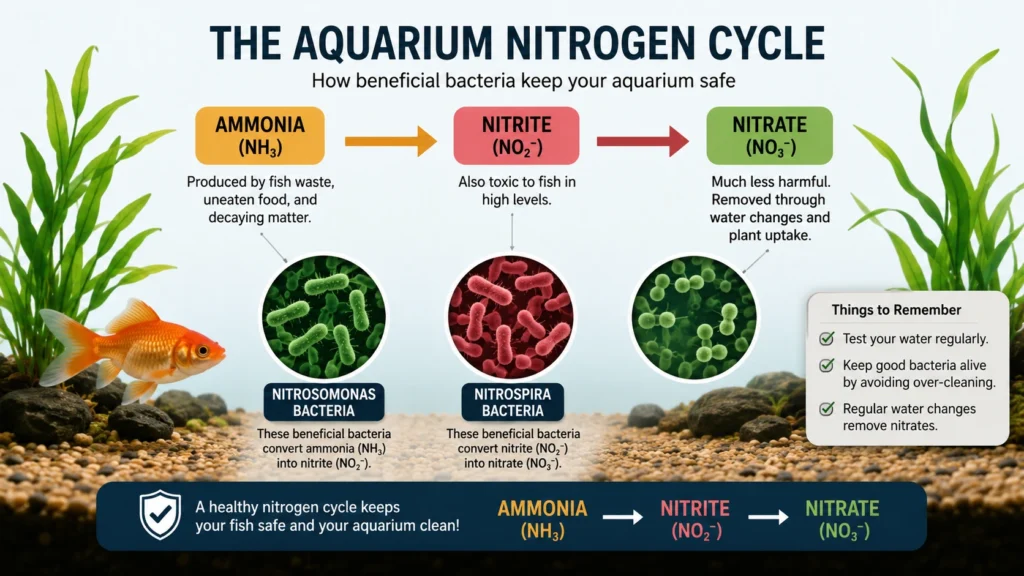
It works in three stages. First, fish waste and decaying food produce ammonia (NH3). Then, one type of bacteria converts that ammonia into nitrite (NO2) — which is actually more toxic than ammonia in many cases, since it interferes with a fish’s ability to carry oxygen in its blood (a condition aquarists sometimes call “brown blood disease”). Finally, a second type of bacteria converts nitrite into nitrate (NO3), which is far less harmful and gets removed through regular water changes.
Meet the Beneficial Bacteria Doing the Work
I like to think of these bacteria as a tiny invisible cleanup crew. The two main species you’re relying on are Nitrosomonas (which handles ammonia) and Nitrospira (which handles nitrite). The catch is, they need to be “hired and trained” first — they don’t exist in any meaningful numbers in a brand new tank. They have to grow, and that takes time.
Why This Process Can’t Be Rushed
This is the part that frustrates every beginner, myself included. Under ideal conditions, these bacteria colonies are generally estimated to double roughly every 15–24 hours, though this varies depending on temperature, oxygen levels, and surface area available for colonization. Even under the best conditions, going from zero to a colony that can support a fully stocked tank still takes weeks, not days. There’s no real shortcut — only ways to support the process.
Now that you know what’s happening at the microscopic level, let’s talk about the two main ways to actually start this process in your own tank.
Fishless Cycling vs. Fish-In Cycling — Which Should You Choose?
This is genuinely one of the most common questions I get from readers, and honestly, my answer hasn’t changed in years.
Fishless Tank Cycling (The Recommended Method)
Fishless tank cycling means you build up your bacteria colony using a pure ammonia source — no fish involved at all. This is what I do now, every single time, and what I recommend to basically everyone. No living creature suffers while the cycle establishes itself, which honestly should be reason enough.
Fish-In Cycling (When You Have No Other Choice)
Sometimes you’ve already bought fish before learning about cycling — and honestly, this is one of the most common messages I get in my inbox and comments, usually written in a slight panic, asking what to do now. Fish-in cycling means cycling the tank with the fish already in it, using hardy species and doing frequent water changes (we’re talking 25–50% every other day) to keep ammonia from building to lethal levels.
Why Most Experienced Keepers Recommend Going Fishless
My honest take? Fish-in cycling is stressful for the fish and stressful for you. You’re constantly testing, constantly changing water, and there’s real risk involved the entire time. Fishless cycling removes that risk entirely — it just asks for patience instead.
If you’re convinced fishless cycling is the safer route — and it usually is — here’s exactly how to do it, step by step.
How to Cycle a Fish Tank Step by Step (The Full Process)
This is the fish tank cycle step by step breakdown I wish someone had handed me back in 2017 when I started.
Step 1 — Set Up Your Tank, Filter, and Substrate
Fill your tank, add your substrate, and get your filter running continuously from day one — it needs constant water flow for bacteria to colonize the media. Add a dechlorinator to your tap water immediately; chlorine and chloramine will kill the very bacteria you’re trying to grow.
Step 2 — Add an Ammonia Source
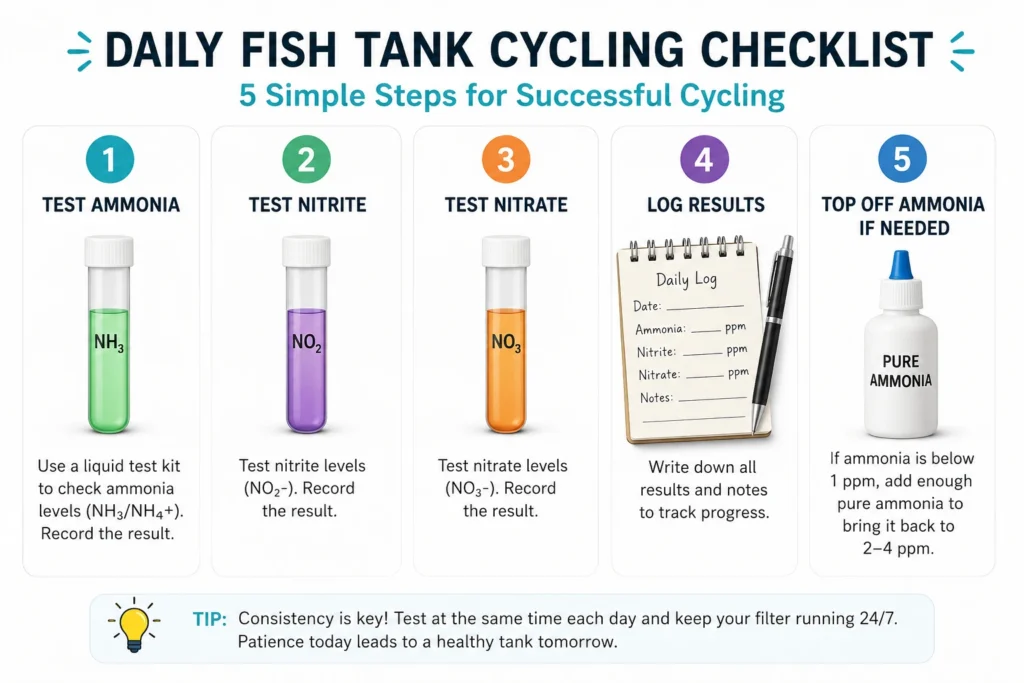
For cycling a new aquarium without fish, add pure ammonia (no surfactants or additives) to bring your tank to around 2-4 ppm. Some people use a few flakes of fish food instead and let it decay naturally — I’ve done both, and pure ammonia gives you more control.
Step 3 — Test, Wait, and Track Your Numbers Daily
Here’s a simple breakdown of what you’re watching for:
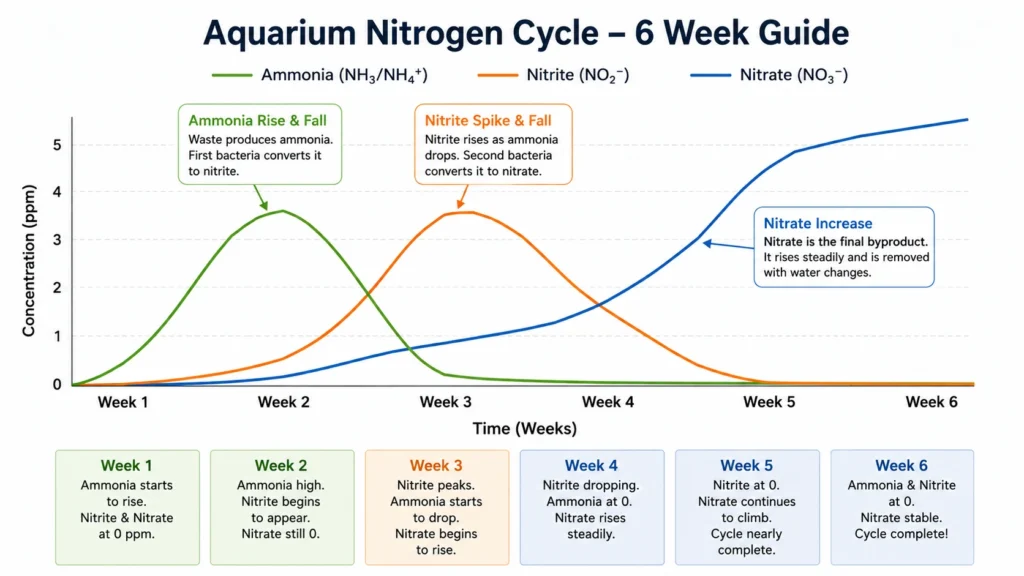
- Week 1-2: Ammonia rises, stays present. Nitrite at zero.
- Week 2-3: Ammonia starts dropping. Nitrite spikes — this is the second bacteria colony establishing.
- Week 3-4: Nitrite starts dropping. Nitrate begins appearing.
- Week 4-6: Ammonia and nitrite both hit 0 ppm consistently within 24 hours of dosing. Cycle complete.
💡 Expert Tip: Don’t just watch ammonia and nitrite — log them. I keep a simple notebook (or a notes app, these days) with the date, ammonia ppm, nitrite ppm, and nitrate ppm every single day during a cycle. It sounds excessive, but seeing the trend on paper is the difference between guessing your tank is cycled and knowing it.
Test daily with a liquid test kit, and redose ammonia whenever it drops below 1 ppm, to keep feeding the bacteria. This is where patience becomes your best friend — and where most beginners either succeed or give up too early.
How Long Does It Take to Cycle a Fish Tank?
I get asked this constantly, and I get why — staring at empty water for a month feels like torture when all you want is fish in there.
Average Timeline (4–6 Weeks Explained)
So, how long does it take to cycle a fish tank? On average, 4 to 6 weeks for a full cycle from scratch. I know that’s not the answer anyone wants to hear, but rushing it just means starting over later — something I’ve done, and don’t recommend repeating.
Factors That Speed Up or Slow Down Cycling
Using filter media, gravel, or even a sponge from an already-established tank can cut this down to as little as 1-2 weeks, since you’re seeding the colony instead of growing it from zero. Cooler water temperatures (below 70°F/21°C) slow bacterial growth significantly, while keeping the tank around 75-80°F (24-27°C) speeds things along.
Signs Your Tank Has Fully Cycled
You’ll know you’re done when ammonia and nitrite both read 0 ppm, and nitrates are climbing steadily — usually somewhere in the 5-20 ppm range before a water change.
Waiting weeks for invisible bacteria to grow can feel pointless — until you understand what’s quietly happening beneath the surface.
Aquarium Water Parameters to Track While Cycling
Tracking the right aquarium water parameters is honestly half the battle here.
Ammonia, Nitrite, and Nitrate — Target Ranges
| Parameter | During Cycling | Fully Cycled Target |
|---|---|---|
| Ammonia | 0.25–4 ppm (rising/falling) | 0 ppm |
| Nitrite | 0–5+ ppm (spikes mid-cycle) | 0 ppm |
| Nitrate | 0 ppm early, rising later | 5–20 ppm (pre-water change) |
pH, Temperature, and Why They Matter Too
Aim for a stable pH between 6.8 and 7.8 for most freshwater community fish, though this isn’t universal — species like discus or wild bettas prefer softer, more acidic water, while African cichlids need higher pH and hardness. If you’re keeping a specific species, it’s worth checking that species’ exact needs rather than defaulting to the general range here. Stability matters more than hitting an exact “perfect” number.
A quick note: the parameters and timelines in this guide reflect general best practices and my own personal experience — always adjust based on your specific species’ needs.
Different fish species have slightly different water parameter requirements. Here’s a quick reference table for some of the most common beginner fish:
| Species | Ideal pH Range | Ideal Temperature |
|---|---|---|
| Betta | 6.5–7.5 | 24–28°C (75–82°F) |
| Goldfish | 7.0–8.0 | 18–24°C (65–75°F) |
| Guppy | 7.0–8.0 | 22–28°C (72–82°F) |
| Zebra Danio | 6.5–7.5 | 18–24°C (65–75°F) |
Best Test Kits for Accurate Readings
Here’s a mistake I made early on: trusting cheap test strips over a liquid test kit. Strips are notoriously inaccurate for ammonia and nitrite specifically — the color gradients are hard to read precisely, and I’ve seen mine give misleading “safe” readings when my liquid kit showed otherwise. I switched to the API Freshwater Master Test Kit years ago because it tests all the parameters that actually matter during a cycle in one box, and I still recommend it to readers today.
Tracking numbers is one thing — but knowing what to do when something looks off is what actually saves your fish.
Common Mistakes That Ruin a Fish Tank Cycle
After seven years of doing this — and helping readers troubleshoot their own tanks in the comments — these are the mistakes I see (and made) most often.
Adding Fish Too Soon
This was my exact mistake in 2017. Don’t add fish until ammonia and nitrite both consistently read zero, even after dosing.
Overcleaning the Filter or Substrate
I once rinsed my filter sponge under hot tap water because it looked dirty. I basically wiped out my entire bacteria colony and had to start the cycle over from scratch. If you need to clean filter media, rinse it gently in removed tank water instead.
Using Tap Water Without Dechlorinating
Chlorine and chloramine in tap water kill beneficial bacteria just as effectively as they kill pathogens. Always dechlorinate before any water change, cycling or not.
⚠️ Common Beginner Mistake: Judging your cycle by how the water looks. Crystal-clear water means nothing about ammonia or nitrite levels — my first tank looked spotless right up until the moment my fish started dying. Always trust your test kit, never your eyes.
Avoid these pitfalls, and you’ll set yourself up for a tank that thrives for years — not just survives the first month.
Quick Checklist: Is Your Tank Ready for Fish?
Before adding any fish, make sure you can check off every item below:
- Ammonia reads 0 ppm within 24 hours of dosing
- Nitrite reads 0 ppm consistently
- Nitrate is present and climbing (5–20 ppm range)
- You’ve held this stable reading for at least 7 days straight (not just once)
- Filter has been running continuously throughout the cycle
- Water has been dechlorinated for every top-off or change
- Temperature and pH are stable and appropriate for your intended species
If you can’t check every box, give it a few more days. I know the wait is hard — but it’s a lot easier than starting over.
Frequently Asked Questions
How long does it take to cycle a fish tank?
Typically 4-6 weeks from scratch, though seeding with established filter media can shorten that to 1-2 weeks.
Can I add fish while my tank is still cycling?
Yes, through fish-in cycling, but it requires frequent water changes — often 25-50% every other day — to keep ammonia from harming your fish. I’d only recommend this if you genuinely have no other option, since it’s harder on both you and the fish than starting fishless.
What’s the fastest way to cycle a new aquarium?
Seeding your filter with media, gravel, or a sponge from an already-established, healthy tank is by far the fastest method I’ve used.
Do I need an ammonia source if I’m not using fish?
Yes — for fishless cycling, you’ll need pure ammonia (2-4 ppm) or a decaying food source to feed the bacteria colony as it grows.
How do I know my tank has finished cycling?
Ammonia and nitrite both read 0 ppm within 24 hours of dosing, and nitrates are present and climbing steadily. I personally like to see this hold steady for a full week before I trust it — a single good reading isn’t enough, since bacteria colonies can still be unstable early on.
Final Thoughts
Looking back at that first tank — the one that killed five neon tetras in four days — I don’t feel embarrassed about it anymore. I feel like it taught me the one lesson every fish keeper eventually has to learn, one way or another: patience isn’t optional in this hobby, it’s the whole foundation. Every cycled tank I’ve run since then, every successful breeding project, traces back to understanding this one process properly.
If there’s one thing I want you to walk away with, it’s this — the wait is worth it. Test your water, feed your bacteria, and trust the process even when it feels like nothing’s happening. Your fish will thank you for it, even if they’ll never know just how close they came to a much worse start.
Kd Sivanath has been keeping and breeding freshwater fish for 7+ years, with hands-on experience cycling tanks for community, breeding, and species-specific setups.
Last updated June 2026 — reviewed for accuracy.

KD Sivanath is an aquarium enthusiast with over 7 years of experience in fish keeping and breeding. He specializes in helping beginners learn simple and effective methods for breeding popular aquarium fish. Through this blog, he shares practical tips, real-life experience, and easy-to-follow guides to help anyone start and succeed in fish breeding.