
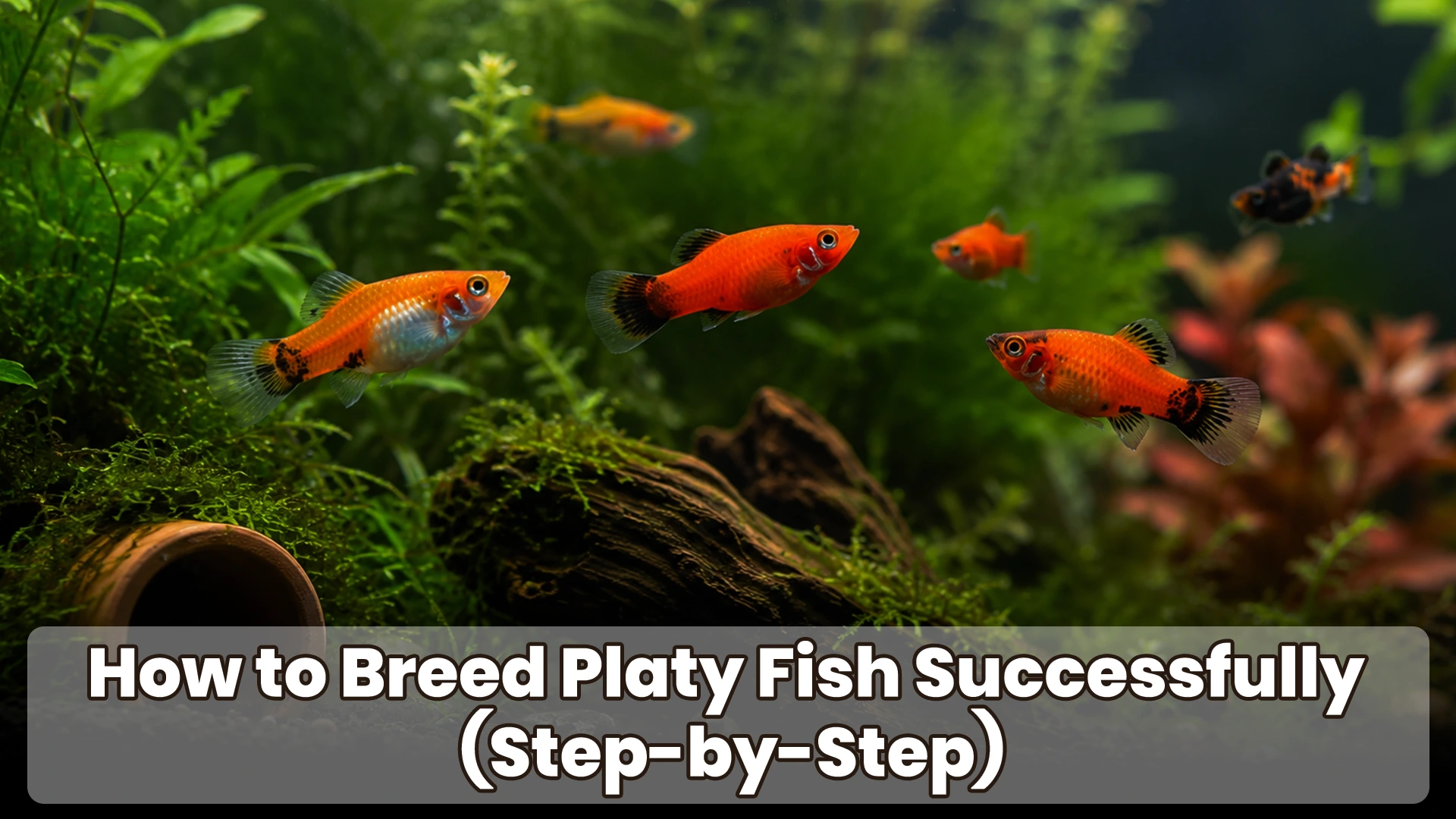
I remember the exact Tuesday morning I walked over to my tank, coffee in hand, half asleep — and froze. There were tiny, comma-shaped things darting around the plants. Dozens of them. My platies had bred, and I hadn’t done a single thing on purpose.
If you’re reading this because you just experienced that same “wait, what?” moment, I get it. Maybe you woke up to a tank full of fry with no idea where they came from. Or maybe it’s the opposite problem — you want your platies to breed, you’ve read a dozen forum posts, and somehow you still end up with zero surviving babies every single time. Both situations are frustrating in their own way, and honestly, I’ve lived through both.
Here’s the good news: platies are genuinely one of the easiest fish in the hobby to breed. You just need to understand the few things that actually matter — not the 47 conflicting tips floating around online. By the end of this guide, you’ll know exactly how to set up a proper breeding tank, spot pregnancy early, and — this is the part most guides skip — actually keep the fry alive.
Let’s start with why platies are actually one of the easiest fish to breed — once you know a few insider tricks.
Why Platy Fish Are Perfect for Beginner Breeders
Livebearers vs. Egg-Layers — The Easy Advantage
Here’s the thing that made breeding click for me early on: platies are livebearers, not egg-layers. That means the female carries her babies internally and gives birth to fully-formed, free-swimming fry — no eggs to fertilize externally, no nest-building, no watching a male fan eggs for days hoping they don’t fungus over. If you’ve ever tried breeding something finicky like angelfish, you’ll understand why platies feel almost too easy by comparison.
How Fast Do Platies Actually Breed?
Female platies reach sexual maturity at around 10 to 12 weeks old, and once mature, they can give birth roughly every 28 days. That’s not a typo — nearly monthly. What surprised me most when I started researching this seriously was learning that a single female can store sperm from one mating and produce multiple broods over several months without a male present again. Wild, right?
Real Talk: My First Accidental Platy Litter
I bought three platies from my local fish store, assured they were “probably all female.” Two weeks later — surprise. Turns out one was already pregnant when I bought her, and I woke up to roughly 20 fry hiding in my java fern. I lost most of them within days because I had zero idea what I was doing. Ever wonder why platies seem to multiply overnight without you doing anything? That’s basically what happened to me, and it’s more common than you’d think.
But before you get more platies breeding intentionally, you need the right home for it to happen safely — let’s talk tank setup.
Platy Breeding Tank Setup (The Foundation)
Ideal Tank Size and Water Parameters
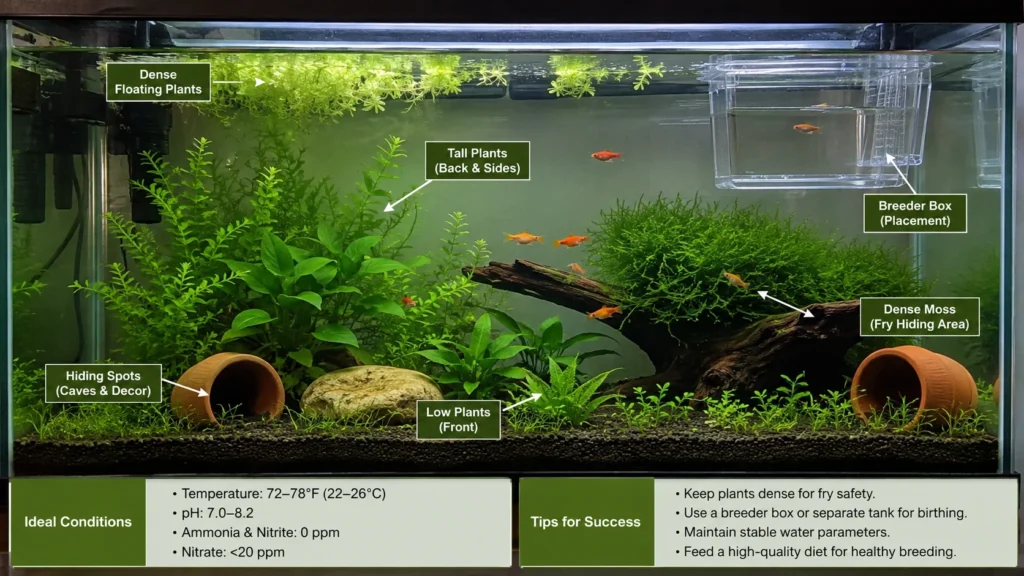
You don’t need anything fancy here. A 10-gallon tank is a solid minimum for a dedicated breeding setup, though I personally prefer 20 gallons if space allows — it gives adults room to spread out and reduces stress-related aggression toward the pregnant female.
Water parameters matter more than people admit:
- Temperature: 72–78°F (22–26°C)
- pH: 7.0–8.2 (platies actually prefer slightly alkaline water)
- Ammonia/Nitrite: 0 ppm, always
- Nitrate: under 20 ppm
Male-to-Female Ratio That Actually Works
My honest take? A ratio of 1 male to 2–3 females works best. A single male chasing one female nonstop will stress her out badly — I learned this the hard way when a female I had stopped eating for nearly a week from constant harassment.
Plants, Hiding Spots & Breeder Boxes
I once ran a bare-bottom breeding tank with no plants, thinking it’d be easier to clean. Fry survival rate? Maybe 10%. The next batch, I packed the tank with dense java moss and hornwort. Survival jumped to somewhere around 60–70%, just from giving fry places to disappear into.
Once your tank is ready, the next question is — how do you actually know breeding is about to happen?
How to Identify a Pregnant Platy
The Gravid Spot Explained
The first time I saw the dark triangle near a female’s tail, I panicked thinking she was sick. Turns out that’s completely normal — it’s called the gravid spot, and it darkens as the babies develop inside her.
Behavioral Signs Before Birth
Watch for a boxier, more angular belly shape (versus just “fat”), and hiding behavior in the days before birth. She’ll often seek out corners or plants.
How Long Is a Platy’s Pregnancy?
Gestation typically runs 24 to 30 days. No eggs. No nests. Just patience.
Now that you can spot a pregnant platy, let’s walk through exactly what happens on breeding day.
Step-by-Step Platy Breeding Process
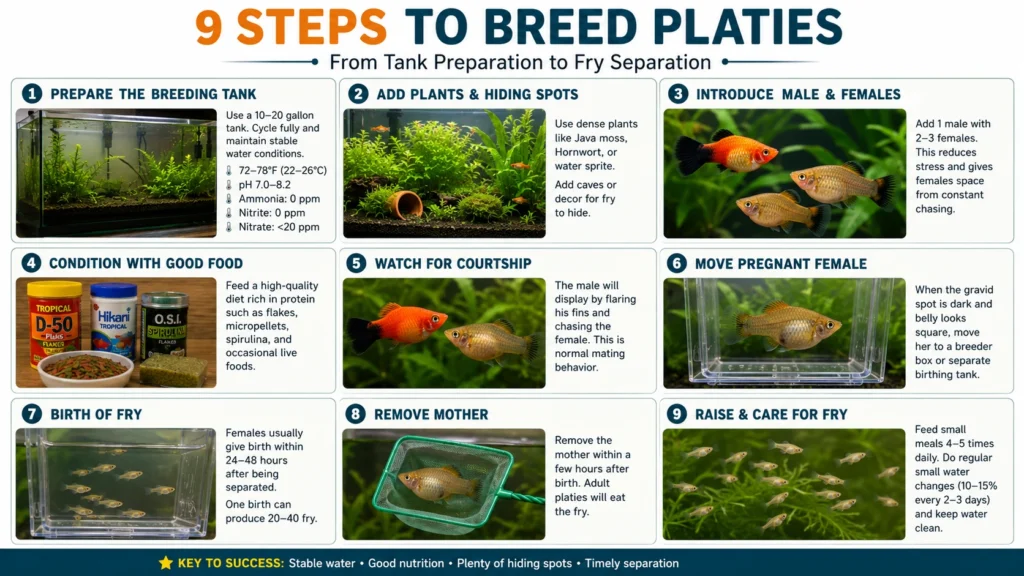
Step 1–3: Preparing the Breeding Tank
- Cycle your breeding tank fully before adding fish — ammonia and nitrite must read zero.
- Add dense plants or a breeder box.
- Match water parameters to your main tank to avoid shock.
Step 4–6: Introducing Male & Female
- Introduce your chosen male and 2–3 females together.
- Feed a protein-rich diet (baby brine shrimp, high-quality flake) to condition them.
- Watch for the male’s courtship display — he’ll flare his fins and chase gently.
Step 7–9: Birth & Immediate Fry Care
- Once the gravid spot darkens and her belly squares off, move her to a separate birthing tank or breeder box.
- Birth usually happens within 24–48 hours of relocation, often producing 20 to 40 fry per litter.
- Remove the mother within a few hours of birth — she’ll eat the fry otherwise.
Getting the fry born is only half the battle — keeping them alive is where most beginners struggle.
Platy Fish Fry Care (Keeping Babies Alive)
Why Adult Platies Eat Their Own Fry
This one’s rough to learn firsthand. Adult platies, including the mother, will absolutely eat fry given the chance. What’s the point of a perfect birth if none of the fry survive the first week? Separation isn’t optional — it’s the single biggest factor in survival rate.
Best Food for Platy Fry (Growth-Boosting Diet)
Feed fry 4–5 small meals a day for the first few weeks. Crushed flake, baby brine shrimp, or commercial fry food all work well. I’ve found fry fed baby brine shrimp grow noticeably faster and color up sooner than those on flake alone.
Water Changes & Fry Tank Maintenance
Do small, frequent water changes — around 10–15% every 2–3 days — since fry tanks foul quickly from overfeeding. This is where I lost an entire batch overnight once, from skipping water changes for a week. Lesson learned, permanently.
With fry care sorted, let’s cover a few advanced tricks that separate hobbyists from true platy breeders.
Pro Tips for Consistent, Healthy Platy Breeding
Selective Breeding for Better Colors
If you’re aiming for specific color strains, only breed fish showing the traits you want consistently across generations.
Avoiding Inbreeding Issues
After years of doing this, here’s what I know: inbreeding weakens fry over generations — smaller size, bent spines, poor coloring. I now trade fish with a local fish club every few months to keep genetics fresh.
Common Mistakes That Kill Fry Survival Rates
- Not separating pregnant females in time
- Overcrowding the fry tank
- Skipping water changes
- Feeding too much at once (fouls water fast)
- Mixing fry with adult fish too early
Real talk — every experienced breeder has made at least three of these mistakes personally. I certainly have.
FAQs About Breeding Platy Fish
How often do platies breed? Roughly every 28 days once mature, as long as a male is present or she’s stored sperm from a previous mating.
How many babies do platies have at once? Typically 20–40 fry per litter, though older, larger females can produce upward of 60.
Do platies need a separate breeding tank? Not strictly required, but highly recommended — survival rates jump dramatically with separation.
How can you tell if a platy is male or female? Males have a pointed anal fin called a gonopodium; females have a rounded, fan-shaped one.
Why do my platy fry keep dying? Usually it’s being eaten by adults, poor water quality, or food too large for their tiny mouths. Separation and small frequent feedings fix most of this.
Final Thoughts
Looking back at that first accidental litter years ago, I honestly had no clue what I was doing — and that’s okay. Every breeder starts there. What matters is understanding the basics: the right tank setup, recognizing pregnancy early, and protecting fry once they arrive.
If there’s one thing I want you to walk away with, it’s this — platy breeding isn’t complicated, it just requires a little patience and a few lessons you’d otherwise learn the hard way. You’ve got those lessons now. Go set up that tank, and don’t be surprised when you start actually looking forward to finding fry in the morning.

KD Sivanath is an aquarium enthusiast with over 7 years of experience in fish keeping and breeding. He specializes in helping beginners learn simple and effective methods for breeding popular aquarium fish. Through this blog, he shares practical tips, real-life experience, and easy-to-follow guides to help anyone start and succeed in fish breeding.